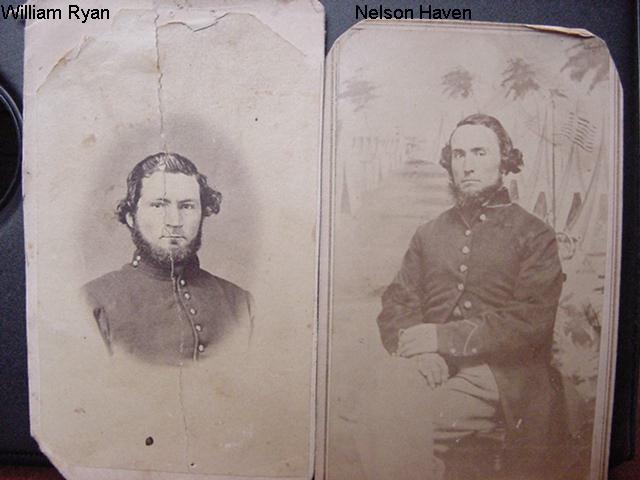
| Research | between 1850 and 1900 | 1850 CENSUS: NEW YORK, NY. New York, Ward 17. "NELSON HAVELAND," 22, "iron crate maker," NY.
NOTE: This MAY be Nelson Haven.
1860 CENSUS: COOK CO., IL. Evanston. Head "JAMES B. COLVIN," 54, merchant, $1400/2000, NY; "CATHERINE," 50, NY; "WILLIAM," 16, IL; "NELSON HAVEN," 35, mariner, NY; "MARY A. HAVEN," 25, NY; "IDA A.," 7, MI; "ADA," 5, IL; "NELLIE," 3, IL; "MINNIE," 7 mos., IL. Plus two "domestics.
1870 CENSUS: IDAHO TERR., Ada, Boise City P.O. "NELSON P. HAVEN," 53, NY.
NOTE: Unable to locate Caroline & girls.
1880 CENSUS: WASHINGTON CO., ID. Lower Weiser Valley. Head "NELSON HAVEN," 56, farmer, NY/NC/GER; Wife "MARY," 44, PA/NY/NY.
NOTE: Nelson's father was b. in MA & his mother was most likely b. in NY or PA, not Germany. The IGI
states that Caroline Pulcifer was b. in "French Point, Prussen". It is more likely that she was b. in
NY or King of Prussia, Montgomery Co., PA.
1900 CENSUS: WASHINGTON CO., ID. East Weiser. Head "NELSON HAVEN," b. Oct 1824, 75, m. 47 yrs., NY/NC/GER; Wife "MARY A," b. July 1835, 66, M. 47 yrs., 4 children/3 living, PA/NY/NY.
NOTE: Daughter Minny and Henry Linder are living almost next door. |
| Biography | | W.H. Linder: During the Indian scare Doc had met a cute, attractive, five foot two, one hundred ten pound girl. She had curly red hair and freckles. She was the youngest daughter of Cap Haven. It seemed to be love at first sight for both Doc and Minnie, and they were married on Minnie's twentieth birthday, October 29, 1879. She taught the first school in Middle Valley.
We will now leave the Linder Tale, and begin . . .
THE HAVEN TALE
Jocton Greene Haven, my great-grandfather, was a nephew of Nathaniel Greene. His mother was Nathaniel's sister. Jocton had a large family. There were two sets of twins: Emmaline and Caroline and Nelson and Harrison. Jocton's wife died when the younger members of the family were small, and he remarried when Nelson was seven years old. Nelson and his step-mother did not get along well, and Nelson ran away from home when he was eleven and joined a band of Indians. He lived with them until he was grown. Then most of his time was spent as interpreter for the whites and Indians in the fur trade. He spoke both languages fluently. Most of his growing up period was spent around the Great Lakes and he learned to love boats and swimming. He was an expert swimmer. At one time when he was racing another man across a four mile wide bay his rival played out when half way across, and Nelson towed him the last two miles and brought him in safely. Due to his love of water, it is not surprising that he became a sailor, first as pilot, then as Captain on a freighter on Lake Michigan.
Later he bought his own ship, and went in business with a merchant in Chicago. He freighted the goods in, and his partner sold them. The partner's name was Marshall Field. Business was good, and they prospered. There was only one thing wrong. There wasn't enough adventure. Things were too calm to suit Nelson. Along about this time he met and married Mary Colvin. Let's go back now, and find out a little about Mary . . .(Molly) to Nelson.
THE COLVIN TALE
James and Kathryn Colvin had three children: Mary, Albert and William. James was in business in Chicago the first we know about him. He had been born in New York State, and there had married Kathryn Garner. They moved to Chicago, where he set up a dry goods store. The little town of Chicago was started in a valley or swale which the Indians named Skunk Hollow . . . the Indian name (Chicago). Since the town was near the Lake shore, the children became good swimmers and skaters. Most of their leisure time was spent on the lake. James was a proper, dignified aristocrat, and brought up his children in a strict manner requiring perfect manners and habits. Uncle Albert came West to visit us, and we were all impressed with his gentlemanly appearance, and his perfect manners. But we were concerned here mainly with Mary. I knew her well, for she lived in our home for twenty years, after Grandfather died, and she was always a perfect lady.
In the little town of Chicago they were all acquainted and did a lot of visiting. Mary and her parents knew Abraham Lincoln well. They also knew his wife, and her parents, the Todds. Mary told this story many times, but always with her hand covering her eyes. It seems Mrs. Todd had beautiful silverware, and being very proud of it, she had her initials engraved on each piece. Her full name was Fanny Anne Rachel Todd.
Mary learned early in life that she had prophetic dreams. She was invited to a dinner party at Marshall Field's home, and the night before the party she dreamed she met a big, tall, handsome, left-handed sailor, fell in love with him and married him. She wasn't at all surprised when Field introduced his partner in business to her, for she immediately recognized him as the man of her dream. They were married soon after.
Now we will go back to Nelson Haven, for that is the man she met and married. He was known now as Captain Haven, later as Cap.
He was a big, husky, six-foot two adventurer and brawler. I remember seeing a dent in his forehead where someone had hit him with an axe when he was a young man. Although he had a good business and a family of three girls, Cap became restless in time. He could think of nothing and talked of nothing but the gold rush to California. His plan was to strike it rich then come back to Chicago, or take his family to a new location in the West. Mary consented, and for fear the news would cause him to change his plans, did not tell him that they had another baby on its way. He left Chicago in June, 1859. I don't know how he traveled the first part of his trip across the plains, but the last half across the mountains, was on foot. In crossing the Cascades, probably Donner's Pass, he and eight other men were caught in a snow storm that turned into a blizzard, which stopped them. They almost starved. They made soup from the rawhide on their snow shoes, hoping it would give them enough nourishment to sustain them. When the blizzard stopped, Cap was the only one strong enough to hunt. He killed two mountain goats. He hid one, and carried one into camp and cooked it. The men were so hungry, he had to fight them back until the meat was cooked, then would let them eat only a small amount at a time. When that goat was gone, he went out and brought the other to camp. By the time this second goat was gone, the men were strong enough to go on to Sacramento Valley.
By the time he arrived, the gold fields were all filed on and pretty well washed out. Cap started a packing business, and delivered supplies to the miners by mule pack train. He stayed on here about three years, and when he heard of a gold strike in Colorado, he pulled out, again seeking gold. He was luckier there, and made a little fortune, but digging gold was too tame so he and a partner established a horse ranch.
A word about his partner. His name was Joel McKee. He was a giant of a man, with long curly blond hair, of which he was very proud. Each morning before a long ride, he would wrap his curls in paper to keep the dust from getting on them. He was so proud of his hair and of his strength, he would have two men hang all their weight from his hair, then would get up and walk with them hanging on. Years later Cap was to learn that Joel McKee was a cousin of Cassey McKee Linder. In a letter to his cousin, Joel said, "Give my regards to my tried and true friend, Cap Haven."
We might record here an amusing incident which demonstrates how lightly Cap considered danger. He was away from camp, and about dark was ambushed by Indians. They surrounded him, and he was caught in their crossfire. Because of their poor marksmanship and the dark, he was able to fight his way through without a scratch. When he returned to camp and related his story, the men asked how many Indians he killed. He replied, "I don't know how many, but I do know I got as many of them as they got of me."
It was while Cap was on his horse ranch that he met his only relative, since he left home. He met William F. Cody, (Buffalo Bill), and in their conversation they discovered they were cousins. They became fast friends.
The partners soon built up a large horse herd and were prospering, but at that time Indian trouble was common. A band of Indians stole some of the partners finest horses, and they immediately applied to the Governor of Colorado Territory for permission to arm men and go after the horses. At that time Colorado was handling Indians very carefully so as not to stir them up , and the Governor refused permission. The partners took things into their own hands, outfitted one hundred men with rifles, horses and saddles, and went out after their stolen stock. While scouting Cap got lost, and seeing the fires of a big camp and supposing it was his, rode right into the Indian camp. Cap, knowing how to handle Indians, rode boldly up to the Chief's teepee, ordered his horse cared for, food for himself and a bed for the night. He also ordered the return of all his horses. They did all they could to make him comfortable, and sent a scout with him the next morning to guide him back to his own camp.
The partners got their horses back, but it didn't do them any good. The Governor immediately ordered their arrest on a charge of treason, (outfitting and arming an army without consent).
Cap and Joel spent eight months in prison before they were released. By the time they got their freedom their horses were scattered all over the West. Then word came of a gold strike in the Boise Basin. Here Cap found gold. He took in a partner named Crawford. They worked their mine for awhile and found it rich in gold-bearing ore. They cleaned up enough to buy equipment, and Cap took a wagon and team and drove to The Dalles where he found the supplies and things they needed. He loaded it on the wagon and drove back to the Basin, only to find his partner had sold out the mine for a lot of money and skipped out. By that time all the claims had been taken, but there was word that up near Lewiston, at Florence, there were some rich diggings. Cap decided to go to Florence.
His plan was to go up the Weiser River, over to the Salmon River, and thus to Florence. There were a few settlers along the lower Weiser River, and Cap stopped at one of these homes to spend the night. These people had recently come from Illinois, and were receiving a Chicago paper. Cap read the paper from front to back. He then sat down to do some serious thinking. He was homesick. He wanted his family. Cap had not written his family for ten years, and of course, had not received any word from them for they had no idea where he was. The paper stated that an old friend of his, James Beveridge, had been elected Governor of Illinois. Cap stayed on in the Weiser River Valley, and wrote to the Governor Beveridge, asking the Governor to locate his family for him and tell them he wanted to get in touch with them. In the meantime, after ten years, Mary had decided Cap was dead, had him declared legally dead and had remarried. She had moved to Muskegon, Michigan. Governor Beveridge gave Mary Cap's address and sent Mary's address to Cap. Letters started going back and forth with the result that Mary, who still loved Cap, got her second marriage annulled, got on the train and rode to Kelton, Utah, the nearest railway stop to the Weiser Valley. With Mary came three girls, plus one who had been born in October, after Cap left in June. This last girl was Minnie, who was now eleven years old. Also with Mary came her Father and Mother, who felt they could not let Mary set out on such a journey without their help. They had no intention of letting Mary go alone to the wild west to meet that wild adventurous husband of hers.
In the meantime, Cap was on his way to Kelton. He got a spring wagon and a good team of horses, and made the journey of over seven hundred miles, met his family and brought them to his homestead. I don't have any details of the trip home except that it was a tiring but happy journey, especially for Minnie, who was seeing her father for the first time. I have a picture in my mind of aristocratic great grandfather Colvin, wearing his broadcloth cutaway coat, white shirt, high, stiff collar and a stovepipe hat. I doubt that I was a pleasure trip for him. Great grandfather came to like and respect Cap, and after they saw how things were out here, went back to Chicago, sold their property, and returned to Weiser to live with Cap and Mary. Great grandmother Kathryn died November 13, 1888. Great grandfather James, who was feeling fine and had gone duck hunting on the morning of her death, lived only nine days after she died. He died November 22, 1888. They died on the Haven Ranch. Cap Haven died March 3, 1906. After his death, Mary lived with Doc and Minnie until her death. She died April 6, 1928. She was 93 years old.
THE LINDER-HAVEN TALE
Doc and Minnie were married on her 20th birthday, October 29, 1879. Since Cap knew very little about ranching he hired Doc to take charge and worked with him. Doc managed the ranch for several years. It was on this ranch that Cassey, Nelson and Ella were born. When Ella was two years old Cap sold the ranch and retired.
Doc and Minnie filed a homestead claim on Cottonwood Creek, south of Council, where Clyde and Cleo were born. They found the snow getting deeper, and staying on longer every winter, and decided to move to a place where they could get around easier. In the spring of 1893, Doc and Minnie released their homestead rights, and sold their improvements to Doc and Minnie Phipps. I understand a member of the Phipps family still own the farm.
During the summer they moved to Salubria where Doc, who always had the finest horses, engaged in freighting supplies from Weiser. Sometimes he made a trip to Boise with the freight wagons. It was while they were living in Salubria that Carl was born. Cassey, Ella and Nelson attended school there.
From Salubria the family moved to a farm on Mann's Creek. Then in 1896 they moved back to Middle Valley. There Doc bought a ranch adjoining his father's place. Here William was born. they moved again in the spring of 1898 to the Payette Valley, and it was there that the youngest, Tom, was born. From Payette, the family moved back to the Cap Haven place which Doc rented from Merritt, who then owned the place. In the spring they moved back to Middle Valley, to the place Doc had bought. He filed a homestead right on 160 acres adjoining the farm and settled down.
In 1908 the Mesa Orchard Company purchased the entire acreage, and the family moved again to a smaller, irrigated farm, close to what had become Midvale. Here the family lived until Father's death in 1939. Mother died in 1947.
LIFE ON THE HOMESTEAD
Most of the foregoing history I got second hand by hearing conversations when I was a boy. The following are things I remember. By this time Cassey had passed away, and Ella died soon after. Nelson was grown and on his own, although he lived at home several years after I was big enough to enter into family life.
We had a board and batten (box) house, with no insulation, and winters the snow would drift through the cracks and across our beds. Our house had two bedrooms on the first floor, and an attic room above where we boys slept. The girls, Ella and Cleo, slept in one of the lower bedrooms, and Father and Mother in the other. Our fuel was wood, which had to be hauled from the mountains. We had no inside plumbing. Our toilet (privy) was about 80 feet from the back of the house, and the trail to it had to be kept free of snow in the winter. Our water came from a well about 60 feet from our front door, and the water had to be pumped and carried to the house. We used kerosene lamps and candles for light. This may sound like a hard life, but we were a happy family and loved every day.
There were no telephones or automobiles in the valley. The fastest way to get a message from one place to another was by horseback. Of course, television and radio were unknown. In 1906 Father (Doc) and Uncle Jim's son-in-law, Walter Henke, decided it was time to build a telephone line. They met with the neighbors and sold the idea. Henke was appointed financial chairman and Father was given the job of construction foreman. Each subscriber was assessed $100.00. Work was started in the spring, and by fall the system was in operation. A board of supervisors was elected, and each subscriber was given a special combination of long and short rings. There were 66 phones on one line, which made many combinations necessary. When one family wanted to get a message to the entire community the agreed signal was a series of short rings (10-15). When that signal was given, everyone of the 66 receivers came down and the message was delivered.
Sometimes it was hard to obtain the line, for usually someone was using it. So the subscribers were taxed another assessment and a telephone office and switchboard were installed dividing the users into 10 party lines. Later the company was sold to Levi Keithley and it became a private enterprise.
Cars began going through the Valley in 1905. One day I looked down the valley and saw a dust which I was sure was raised by a car. I ran three-quarters of a mile and got to the road just in time to watch it go by. It was the first horseless carriage I had ever seen.
It was hard for the old-timer to make the change from horses to cars and some amusing incidents occurred. An old neighbor purchased a car and drove it home. He had a board gate at the entrance to his ranch. When he got to the closed gate he yelled, "Whoa, whoa", and drove right through tearing the gate to pieces.
Uncle Jim bought a new Mitchell. He had erected a good garage with a door in the front end. When he drove in, he forgot which was the accelerator and which was the brake. He pressed hard on the accelerator and went right on through taking the end of the garage with him. He solved the problem though by putting a wide door in both ends of the garage.
Every Fall cattle buyers started collecting a drove at Meadows, and bought all that were for sale as they drove the herd south. They drove the cattle to Weiser where they were shipped by train to Portland. Both sides of our roads were fenced with a space between of 60 feet. By the time the drove got to the lower end of Middle Valley it would be 60 feet wide and abut two miles long. It was quite a sight for a boy to watch.
Each summer in spare time we cleared new ground of sage brush for fall plowing. Father and the older boys grubbed brush and we smaller boys piled it in large piles. Then we would celebrate by burning this brush after dark. In that way we enlarged our farm acreage each year. By 1980 we had all the flat in production. That was the year that Mesa Orchard Company started plans for their project. Their advance man purchased our place. We were not happy to leave for we loved our old homestead.
THE FAMILY
FATHER
No family was ever blessed with a finer father than ours. He raised eight children without punishing physically. He was so kind and understanding, a word of disapproval from him was really punishment. He wasn't a big man, 5'10" in height and weight around 165 pounds. When a young man he never found a man who could beat him in a wrestling match or out-run him. In a conversation with one of his old friends, a giant of a man, 240 pounds of muscle, the man said to me, "Your father and I were wheel horses when we were young. I remarked that since he was so much bigger than Father, he probably was much stronger. I will never forget his answer. He shook his finger in my face and replied, "Young man, your Father never pled size to any man."
He and Mother were both church-going Christians and lived their belief every day. Father was a good companion and we children never knew there was a generation gap.
MOTHER
There never was a woman with higher morals, no more love for her husband and children than my Mother. She took over in discipline where Father left off. I have received a good many spankings from her which I richly deserved. She was a little impatient at times, but always when there was a cause for it. Father set a good example for us, and Mother forced us to follow.
NELSON
Nelson was a super horseman and did considerable horse-breaking for neighbors and the family, as well as holding down a steady job on neighboring ranches. He was a kind, considerate, patient older brother.
CLYDE
Clyde was a builder. Even as a boy he was always building. He could do most any job and do it well. Clyde was very unselfish. He always took care of the other fellow first. He gave of himself and his wealth. He lived for others.
CLEO
Cleo was the baby of the family. She was teased, loved, patted and spoiled by the entire family. She was a fine sister.
CARL
Carl was a natural farmer and loved farm work. He was able to do a man's work day after day by the time he was 13, and was glad to do it. Carl was a campion of the weak. The only fights he ever had were to protect a smaller boy or a man from a bully. He never used his great strength to tyrannize over others.
TOM
Tom, the youngest, was a big-hearted, tender-hearted, generous, timid guy, who lacked self-confidence, but never let his timidity keep him from doing anything any other boy could do. He always had warm friends because he was a warm, loyal friend.
STANDING JOKES IN THE FAMILY
The first day Nelson was in school, the teacher wrote on the board for him to copy, "Nelson Linder, District Number 20". Cassey, who could read but was not familiar with the word district, was indignant, and could hardly wait to report at home the indignity the family had suffered. The teacher had written, where all could see, "Nelson Linder, Dirty-neck Number 20."
When Clyde was abut 13 years old, he was in town one evening and go t in a fight with a boy his size. Clyde had thick, curly hair, and the other boy who was getting the worst of the fight, grabbed Clyde's hair and pulled out a handful. When Clyde reported the fracas at home, Father asked, "Clyde, did he pull it all out?" Clyde replied, "Nope, the part is still there."
After Uncle Albert returned to Chicago, he and Ella kept in touch by letter as long as Ella was able to write. In one of his letters he said, "Give my love to your amiable little sister." Cleo asked Ella what amiable meant. Ella led her to believe it meant not quite normal. Cleo stormed all over the place. Ella let her rave for quite awhile, then told her the correct meaning.
One day when Ather and Mother were going to town, Carl asked if he might go too. Mother said, "Yes, you can go". Carl asked, "Will I have to wash my neck and clean up?" Mother said of course he would. Carl said, "Then I'll just stay home".
The next story wasn't really a joke. It was simply a misunderstanding. I had a new hat, which was my greatest treasure. One evening while playing, Cleo came out to gather eggs. She had brought nothing to put them in so she took my hat and put eggs in it. I was indignant. What four year old wouldn't be? I called to Mother to tell her the terrible thing Cleo had done. It didn't come out as I intended. What I actually yelled was, "Mommy, Cleo took my hat! I've gotta go bald-headed! Full of eggs! I wondered why my mother laughed so hard.
One time the family was traveling in a bobsled against a very strong, cold wind. It was snowing hard, and the wind lashing our faces made us very uncomfortable. Tom, four years old, said, "I hope the wind changes before we start back."
The older generation often got together on Sundays and enjoyed dinner and a visit. At one of these gatherings, Custer Hartley, three years old, who needed to go to the privy, tried in vain to get his mother's attention. At last he began crying. Aunt Lizzie said, "Custer, what is the matter?" Custer replied, "You just set, and set, and set, and see what me done!"
END OF THE TALE
W.H. Linder
410 E. Butterfield2 |