Paul Bartlett Van Buren Genealogy
Person Page 298
Daniel Cleason
M, #7426, d. 2 July 1702
Biography
Daniel Cleason was born.
Daniel Cleason died DEATH: FHL Fiche #6046912, Rhode Island Vital Records 1636-1850, Vol. 4, Tiverton Births and Deaths 4/7, page 63, 1- CLOSSON, Daniel, died July 2, 1702. on 2 July 1702 in Tiverton, Newport County, Rhode Island.
Daniel Cleason died DEATH: FHL Fiche #6046912, Rhode Island Vital Records 1636-1850, Vol. 4, Tiverton Births and Deaths 4/7, page 63, 1- CLOSSON, Daniel, died July 2, 1702. on 2 July 1702 in Tiverton, Newport County, Rhode Island.
Daniel Cleason was also known as Daniel Closson.
| Last Edited | 23 June 2009 |
??? Dix
M, #7427
| Pedigree Link |
Family:
| Son | William Dix |
| Daughter | Dorothy Dox+ (d. circa 1607) |
| Son | Leonard Dix (b. circa 1624, d. 7 December 1697) |
| Last Edited | 13 July 2022 |
William Dix
M, #7428
Parents
| Father | ??? Dix |
| Pedigree Link |
Biography
William Dix was buried on 1 March 1676/77 in Hartford, Hartford County, Connecticut.
| Last Edited | 21 March 2000 |
Leonard Dix
M, #7429, b. circa 1624, d. 7 December 1697
Parents
| Father | ??? Dix |
| Pedigree Link |
Biography
Leonard Dix was born circa 1624 in Wethersfield, Hartford County, Connecticut, CAVEAT: This birth date seems too early.1
Leonard Dix died on 7 December 1697 at age ~73. He was buried on 4 March 1697/98 in Wethersfield, Hartford County, Connecticut.2
Leonard Dix died on 7 December 1697 at age ~73. He was buried on 4 March 1697/98 in Wethersfield, Hartford County, Connecticut.2
| Last Edited | 1 July 2022 |
Citations
- [S1560] Filae Family Tree, online www.myheritage, Filae Family Trees
Leonard DIX
Birth: 1624, Wethersfield, Hartford, Connecticut
Marriage: Marriage to: Sarah Mary BIDWELL, 1645, Wethersfield, Hartford, Connecticut
Marriage: Marriage to: Sarah Mary BIDWELL, 1658, Death: Dec 7 1697, Wethersfield, Hartford County, Connecticut
Father: William DYKE DYKES
Wife: Sarah Mary BIDWELL. Hereinafter cited as Filae Family Tree. - [S1560] Filae Family Tree, online www.myheritage.
Lucy Williams II1
F, #7430, b. 23 January 1778, d. 29 September 1862
Parents
| Father | Lt. Joseph Williams, Sr. (b. 11 June 1744, d. 11 November 1837) |
| Mother | Mary Unknown (b. circa 1736, d. 1791) |
| Pedigree Link |
Family: Capt. Samuel M. Bartlett (b. 24 January 1774, d. 20 March 1855)
| Son | Marlin Bartlett I (b. 2 October 1797, d. 24 September 1800) |
| Daughter | Minerva Bartlett+ (b. 19 December 1799, d. 9 March 1868) |
| Daughter | Miranda Bartlett I (b. 30 March 1802, d. 10 October 1803) |
| Daughter | Miranda Bartlett II+ (b. 30 January 1804, d. 5 November 1892) |
| Son | Marlin Bartlett II (b. 2 April 1806) |
| Daughter | Maria Bartlett (b. 14 November 1808) |
| Son | Elisha Williams Bartlett+ (b. 30 March 1811, d. 11 August 1880) |
| Son | Samuel "Mixter" Bartlett (b. 21 August 1813, d. 7 July 1889) |
| Daughter | Mary Lucy Bartlett (b. 3 November 1816) |
| Daughter | Louisa Bartlett I (b. 21 July 1819, d. 8 September 1821) |
| Daughter | Louisa Bartlett II+ (b. 23 November 1822, d. 26 August 1903) |
Biography
Lucy Williams II was born on 23 January 1778 in Greenfield, Hampshire County, after 1811 Franklin County, Massachusetts. [According to her gravestone, she died on 29 September 1862 at age 84, so she was probably born in about 1778.
Her death record for Leverett, Massachusetts in Vol. 156, page 305 of Massachusetts Vital Records, 1841-1910 (which is strangely crossed out), states that she was born in Leverett and that her father was Joseph Williams. Her death record for Northampton, Massachusetts, states that she died at 84 years, 7 months of old age [which would make her born in about February 1778] and that her father's [last] name was Williams.
The 1903 death record of her daughter Louisa Bartlett Marsh gives her place of birth as Greenfield [now in Franklin County, which was created from Hampshire County in 1811], Massachusetts. Greenfield is about 15 miles north of Leverett.
James Avery Smith gives her date of birth as 24 January 1774 and her place of brith as Greenfield [Franklin County], Massaschusetts. However, she is not foiund in the Greenfield Vital Records.
The History of Leverett, Massachusets, gives her birth place as Northampton, Massachusetts.].2,3,4,5,6,7
Lucy Williams II married Capt. Samuel M. Bartlett, son of Sgt. Jonathan Bartlett, Sr., and Ann Mixer, circa 1796 in Northampton, Hampshire County, Massachusetts.8 Lucy Williams II died of old age at age 84. on 29 September 1862 in Northampton, Hampshire County, Massachusetts, at age 84. According to the Massachusetts Vital Records for Leverett, Massachusetts, she was a resident of Leverett, but she died in Northampton, a widow. It also states that her father was Joseph Williams. Her death record for Northampton, Massachusetts, states that she died at 84 years, 7 months of old age and that her father's name was Jose[hp Williams.9,10,11 She was buried in Long Plain (aka Hillsboro or Leverett Station) Cemetery, Leverett, Franklin County, Massachusetts. Her gravestone reads:
Lucy
Wife of Samuel Bartlett
Died Sep. 29, 1862
Æ 84 yrs.9,6
Her death record for Leverett, Massachusetts in Vol. 156, page 305 of Massachusetts Vital Records, 1841-1910 (which is strangely crossed out), states that she was born in Leverett and that her father was Joseph Williams. Her death record for Northampton, Massachusetts, states that she died at 84 years, 7 months of old age [which would make her born in about February 1778] and that her father's [last] name was Williams.
The 1903 death record of her daughter Louisa Bartlett Marsh gives her place of birth as Greenfield [now in Franklin County, which was created from Hampshire County in 1811], Massachusetts. Greenfield is about 15 miles north of Leverett.
James Avery Smith gives her date of birth as 24 January 1774 and her place of brith as Greenfield [Franklin County], Massaschusetts. However, she is not foiund in the Greenfield Vital Records.
The History of Leverett, Massachusets, gives her birth place as Northampton, Massachusetts.].2,3,4,5,6,7
Lucy Williams II married Capt. Samuel M. Bartlett, son of Sgt. Jonathan Bartlett, Sr., and Ann Mixer, circa 1796 in Northampton, Hampshire County, Massachusetts.8 Lucy Williams II died of old age at age 84. on 29 September 1862 in Northampton, Hampshire County, Massachusetts, at age 84. According to the Massachusetts Vital Records for Leverett, Massachusetts, she was a resident of Leverett, but she died in Northampton, a widow. It also states that her father was Joseph Williams. Her death record for Northampton, Massachusetts, states that she died at 84 years, 7 months of old age and that her father's name was Jose[hp Williams.9,10,11 She was buried in Long Plain (aka Hillsboro or Leverett Station) Cemetery, Leverett, Franklin County, Massachusetts. Her gravestone reads:
Lucy
Wife of Samuel Bartlett
Died Sep. 29, 1862
Æ 84 yrs.9,6
Lucy Williams II was baptized on 27 June 1779 in Middletown, Middlesex County, Connecticut. ].12
Lucy Bartlett and Capt. Samuel M. Bartlett appeared on the census of 1800 in Leverett, Hampshire County, Massachusetts, which lists in the Samuel Bartlett household one male age 26-44 (Samuel would have been about 26), one female age 16 to 24 (Lucy would have been about 22), one male under 10 (Marlin I would have been about 3 and would die later in 1800), and one female under10 (Minerva would have been about 1).13
Lucy Bartlett and Capt. Samuel M. Bartlett appeared on the census of 1810 in Leverett, Hampshire County, Massachusetts, which lists a Samuel Bartlett household, with one male age 26 to 44 (Samuel would have been about 42), one male under 10 (Marlin II would have been about 4), one female age 26 to 44 (Lucy would have been about 32), and three females under 10 (Minerva might have been about 10, Miranda II would have been about 6, and Maria would have been about 2).14
Lucy Bartlett and Capt. Samuel M. Bartlett appeared on the census of 1820 in Leverett, Franklin County, Massachusetts, which lists a Samuel Bartlett household with one male age 45 and over (Samuel would have been about 46), one male age 10 to 16 (Marlin II would have been about 14), two males under age 10 (Elisha would have been about 9 and Samuel Mixter would have been about 7), one female age 26 to 45 (Lucy would have been about 42), one female age 10 to 16 (Miranda II would have been about 16 and Maria, if alive, would have been about 12), and two females under age 10 (Louisa I, who was to die in 1821, would have been about 1).15
Lucy Bartlett and Capt. Samuel M. Bartlett appeared on the census of 1830 in Leverett, Franklin County, Massachusetts, which lists a Samuel Bartlet [sic] household with one male age 50 to 60 (Samuel would have been about 56), one male age 20 to 30 (perhaps son Marlin II who would have been about 24), one female age 50 to 60 (Lucy would have been about 52), and one female under age 5 (perhaps a granddaughter).16
Lucy Bartlett and Capt. Samuel M. Bartlett appeared on the census of 1840 in Leverett, Franklin County, Massachusetts, which lists a Samuel Bartlett household, with one male age 60 to 70 (Samuel would have been about 66), one female age 60 to 70 (Lucy would have been about 62), and one female under 5, probably their granddaughter Ellen M. Dickinson, then about 4, who was 14 when she was living with them in the 1850 census.17
Lucy Bartlett and Capt. Samuel M. Bartlett appeared on the census of 1850 in Leverett, Franklin County, Massachusetts, which lists Samuel Bartlett, 76; his wife Lucy, 72; and their granddaughter Ellen M. Dickinson, 14, attending school (all born in Massachusetts).
Household Members in 1850 Census:
Name Age
Samuel Bartlett 76
Lucy Bartlett 72
Ellen M Dickinson 14 (daughter of their widowed daughter Minerva Bartlett Dickinson.)18 She appeared on the census of 1860 in the household of Silas Ball, Jr., and Miranda Ball in Leverett, Franklin County, Massachusetts, which lists Silas Ball, 55, born in Massachusetts; his wife Maranda [sic], 55, born in Massachusetts; their son George F. Ball, 25, born in Massachusetts; Miranda's widowed mother, Lucy Bartlett, 82, born in Massachusetts; and Lucy's grandson (and Miranda's nephew), Henry Bartlett, 19, born in New York. Maranda Bartlett Bell was Henry's aunt, a sister of his father Elisha Williams Bartlett.3
Lucy Bartlett and Capt. Samuel M. Bartlett appeared on the census of 1800 in Leverett, Hampshire County, Massachusetts, which lists in the Samuel Bartlett household one male age 26-44 (Samuel would have been about 26), one female age 16 to 24 (Lucy would have been about 22), one male under 10 (Marlin I would have been about 3 and would die later in 1800), and one female under10 (Minerva would have been about 1).13
Lucy Bartlett and Capt. Samuel M. Bartlett appeared on the census of 1810 in Leverett, Hampshire County, Massachusetts, which lists a Samuel Bartlett household, with one male age 26 to 44 (Samuel would have been about 42), one male under 10 (Marlin II would have been about 4), one female age 26 to 44 (Lucy would have been about 32), and three females under 10 (Minerva might have been about 10, Miranda II would have been about 6, and Maria would have been about 2).14
Lucy Bartlett and Capt. Samuel M. Bartlett appeared on the census of 1820 in Leverett, Franklin County, Massachusetts, which lists a Samuel Bartlett household with one male age 45 and over (Samuel would have been about 46), one male age 10 to 16 (Marlin II would have been about 14), two males under age 10 (Elisha would have been about 9 and Samuel Mixter would have been about 7), one female age 26 to 45 (Lucy would have been about 42), one female age 10 to 16 (Miranda II would have been about 16 and Maria, if alive, would have been about 12), and two females under age 10 (Louisa I, who was to die in 1821, would have been about 1).15
Lucy Bartlett and Capt. Samuel M. Bartlett appeared on the census of 1830 in Leverett, Franklin County, Massachusetts, which lists a Samuel Bartlet [sic] household with one male age 50 to 60 (Samuel would have been about 56), one male age 20 to 30 (perhaps son Marlin II who would have been about 24), one female age 50 to 60 (Lucy would have been about 52), and one female under age 5 (perhaps a granddaughter).16
Lucy Bartlett and Capt. Samuel M. Bartlett appeared on the census of 1840 in Leverett, Franklin County, Massachusetts, which lists a Samuel Bartlett household, with one male age 60 to 70 (Samuel would have been about 66), one female age 60 to 70 (Lucy would have been about 62), and one female under 5, probably their granddaughter Ellen M. Dickinson, then about 4, who was 14 when she was living with them in the 1850 census.17
Lucy Bartlett and Capt. Samuel M. Bartlett appeared on the census of 1850 in Leverett, Franklin County, Massachusetts, which lists Samuel Bartlett, 76; his wife Lucy, 72; and their granddaughter Ellen M. Dickinson, 14, attending school (all born in Massachusetts).
Household Members in 1850 Census:
Name Age
Samuel Bartlett 76
Lucy Bartlett 72
Ellen M Dickinson 14 (daughter of their widowed daughter Minerva Bartlett Dickinson.)18 She appeared on the census of 1860 in the household of Silas Ball, Jr., and Miranda Ball in Leverett, Franklin County, Massachusetts, which lists Silas Ball, 55, born in Massachusetts; his wife Maranda [sic], 55, born in Massachusetts; their son George F. Ball, 25, born in Massachusetts; Miranda's widowed mother, Lucy Bartlett, 82, born in Massachusetts; and Lucy's grandson (and Miranda's nephew), Henry Bartlett, 19, born in New York. Maranda Bartlett Bell was Henry's aunt, a sister of his father Elisha Williams Bartlett.3
| Last Edited | 11 July 2025 |
Citations
- [S841] Massachusetts Vital Records, 1841 - 1910, online www.newenglandancestors.org, Volume 156, page 305. Hereinafter cited as Massachusetts Vital Records, 1841 - 1910.
- [S14] 1850 U.S. Census, www.ancestry.com, Samuel Bartlett household, Leverett, Franklin County, Massachusetts.
- [S9] 1860 U.S. Census, www.ancestry.com, Silas Ball household, Leverett, Franklin County, Massachusetts.
- [S841] Massachusetts Vital Records, 1841 - 1910, online www.newenglandancestors.org, Vol. 156, page 305.
- [S852] A History of Leverett Massachusetts Together with a Genealogy of its Early Inhabitants (Bountiful, Utah 84010: Family History Publishers, 1996), page 354. Hereinafter cited as History of Leverett, Massachusetts.
- [S451] Cemetery Gravestone viewed by Paul B. Van Buren.
- [S1668] Massachusetts State Vital Records, 1841-1925 (Family Search), online www.familysearch.com, Death • Massachusetts State Vital Records, 1841-1925
Name Miranda B. Dickinson
Sex Female
Age 68
Birth Year (Estimated) 1800
Birthplace Leverett, Ma.
Residence Place Amherst, Ma.
Marital Status Widowed
Father's Name Sam'l. Bartlett
Father's Sex Male
Father's Birthplace Leverett, Ma.
Mother's Name Lucy William Bartlett
Mother's Sex Female
Mother's Birthplace Greenfield, Ma.
Event Type Death from paralysis (stroke)
Event Date 9 March1868, at age 68 ears, 2 months & 19 days
Event Place Amherst, Hampshire, Massachusetts, United States
Source Details v 212 p 46
Cite This Record: "Massachusetts State Vital Records, 1841-1925", , FamilySearch (https://www.familysearch.org/ark:/61903/1:1:N7VM-8F9 : Wed May 22 22:20:14 UTC 2024), Entry for Miranda B. Dickinson and Sam'l. Bartlett, 1868. Hereinafter cited as Massachusetts State Vital Records, 1841-1925 (Family Search.) - [S852] History of Leverett, Massachusetts, pages 156 & 354.
- [S768] Walter E. & Lottie Corbin, The Corbin Collection, Vol. 3 - Records of Berkshire & Franklin Counties, Massachusetts., CD-ROM (Boston, MA: New England Historic Genealogical Society, 2005), Records of Berkshire & Franklin Counties, Massachusetts. Hereinafter cited as Corbin Collection, Vol. 3.
- [S841] Massachusetts Vital Records, 1841 - 1910, online www.newenglandancestors.org, Vol: 156 ; Page: 305 (Levertt) & Vol: 157 ; Page: 70 (Northampton)
- Lucy Bartlett. - [S1686] Massachusetts, State Vital Records, 1638-1927 (FS)
, online www.familysearch.org, Death • Massachusetts, State Vital Records, 1638-1927
Name Lucy Bartlett
Sex Female
Age 84
Birth Year (Estimated) 1778
Birthplace Leverett
Residence Place Northampton, MA
Marital Status Widowed
Race White
Father's Name Williams
Father's Sex Male
Event Type Death
Event Date 1862
Event Place Northampton, Hampshire, Massachusetts, United States
Source Details v 157 p 70
Cite This Record: "Massachusetts, State Vital Records, 1638-1927", FamilySearch (https://www.familysearch.org/ark:/61903/1:1:N7NJ-1NL : Wed May 22 22:02:47 UTC 2024), Entry for Lucy Bartlett and Williams, 1862. Hereinafter cited as Massachusetts, State Vital Records, 1638-1927,(FS.) - [S1166] Connecticut, Church Record Abstracts, 1630-1920, online www.ancestry.com, Vol. 070, Part 2, Middletown, CT: WILLIAMS, Lucy, daughter of Joseph, bp. June 27, 1779, Vol. 2, page 70. Hereinafter cited as Connecticut, Church Record Abstracts, 1630-1920.
- [S705] 1790 U.S. Census, www.ancestry.com, Samuel Bartlett household, Levevett, Hampshire (later Franklin) County, Massachusetts.
- [S707] 1810 U.S. Census, www.ancestry.com, Samuel Bartlett household, Leverett, Hampshire County, Massachusetts.
- [S708] 1820 U.S. Census, www.ancestry.com, Samuel Bartlett household, Leverett, Franklin County, Massachusetts.
- [S709] 1830 U.S. Census, www.ancestry.com, Samuel Bartlet [sic, mis-indexed as Brtlet] household, Leverett, Franklin County, Massachusetts.
- [S710] 1840 U.S. Census, www.ancestry.com, Samuel Bartlett household, Leverett, Franklin County, Massachusetts
1840 United States Federal Census
Name: Samuel Bartlett
Home in 1840 (City, County, State): Leverett, Franklin, Massachusetts
Free White Persons - Males - 60 thru 69: 1
Free White Persons - Females - Under 5: 1
Free White Persons - Females - 60 thru 69: 1
Persons Employed in Manufacture and Trade: 1
Free White Persons - Under 20: 1
Total Free White Persons: 3
Total All Persons - Free White, Free Colored, Slaves: 3. - [S14] 1850 U.S. Census, www.ancestry.com, 1850 United States Federal Census
Name: Samuel Bartlett
Gender: Male
Age: 76
Birth Year: abt 1774
Birthplace: Massachusetts
Home in 1850: Leverett, Franklin, Massachusetts, USA
Occupation: Shoe Maker
Industry: Footwear, Except Rubber
Real Estate: 400
Line Number: 16
Dwelling Number: 12
Family Number: 14
Household Members:
Name Age
Samuel Bartlett 76
Lucy Bartlett 72
Ellen M Dickinson 14.
Samuel "Mixter" Bartlett
M, #7431, b. 21 August 1813, d. 7 July 1889
Parents
| Father | Capt. Samuel M. Bartlett (b. 24 January 1774, d. 20 March 1855) |
| Mother | Lucy Williams II (b. 23 January 1778, d. 29 September 1862) |
| Pedigree Link |
Biography
Samuel "Mixter" Bartlett was born on 21 August 1813 in Leverett, Franklin County, Massachusetts, (His death on 7 July 1889 at age 75 years, 10 months and 12 days would make his birth date 25 August 1813, but I believe the 21 August date is correct.)
.1,2,3
Samuel "Mixter" Bartlett died of acute gastro enteritis on 7 July 1889 in Leverett, Franklin County, Massachusetts, at age 75. In his death record listed in Massachusetts Vital Records, 1841-1910, his age at death is at age is 75 years, 10 months and 12 days and his father is listed as Samuel Bartlett and his mother as Lavina Bartlett.2,3 He was buried in Long Plain (aka Hillsboro or Leverett Station) Cemetery, Leverett, Franklin County, Massachusetts. His gravestone reads:
Samuel M. Bartlett
Born Aug. 22, 1813
Died July 8, 1889
A member of the 34th Illinois Reg't.1,4,3
.1,2,3
Samuel "Mixter" Bartlett died of acute gastro enteritis on 7 July 1889 in Leverett, Franklin County, Massachusetts, at age 75. In his death record listed in Massachusetts Vital Records, 1841-1910, his age at death is at age is 75 years, 10 months and 12 days and his father is listed as Samuel Bartlett and his mother as Lavina Bartlett.2,3 He was buried in Long Plain (aka Hillsboro or Leverett Station) Cemetery, Leverett, Franklin County, Massachusetts. His gravestone reads:
Samuel M. Bartlett
Born Aug. 22, 1813
Died July 8, 1889
A member of the 34th Illinois Reg't.1,4,3
Samuel "Mixter" Bartlett appeared on the census of 1820 in the household of Capt. Samuel M. Bartlett and Lucy Bartlett in Leverett, Franklin County, Massachusetts, which lists a Samuel Bartlett household with one male age 45 and over (Samuel would have been about 46), one male age 10 to 16 (Marlin II would have been about 14), two males under age 10 (Elisha would have been about 9 and Samuel Mixter would have been about 7), one female age 26 to 45 (Lucy would have been about 42), one female age 10 to 16 (Miranda II would have been about 16 and Maria, if alive, would have been about 12), and two females under age 10 (Louisa I, who was to die in 1821, would have been about 1).5
Samuel "Mixter" Bartlett appeared on the census of 1850 in Leverett, Franklin County, Massachusetts, which lists a Mixter Bartlett, 18 [sic, he would have about 38], single, born in Massachusetts, living apparently as a farm laborer in the household of Moses Field, Sr.6 He was a farmer in 1850.6
He was a member of Company K of the 34th Illinois Regiment, in the Civil War between 1861 and 1864. Note: This is somewhat hard to believe, especially because he would have been around 50 years old, but the source is Corbin and it is also on his gravestone, as well as in:
HISTORY of WHITESIDE COUNTY, ILLINOIS, From Its Earliest Settlement to 1908, ILLUSTRATED With Biographical Sketches of some Prominent Citizens of the County, By William W. Davis, M. A., The Pioner Publishing Co., Chicago, 1908:
RECRUITS, 34th Illinois Regiment, Company. K, [Englisted] 1861.
Bartlett, Sam'l. M. 0. [Mustered Out] Dec. 2, 1864. In service three years.
U.S. Civil War Soldiers, 1861-1865
[National Park Service. U.S. Civil War Soldiers, 1861-1865 [database on-line]. Provo, UT, USA: Ancestry.com Operations Inc, 2007. Original data: National Park Service, Civil War Soldiers and Sailors System, online <http://www.itd.nps.gov/cwss/>]
Name: Samuel Bartlett
Side: Union
Regiment State/Origin: Illinois
Regiment Name: 34th Regiment, Illinois Infantry
Company: K
Rank In: Private
Rank Out: Private
Film Number: M539 roll 5
His service in the Civil War from Illinois may explain why I cannot find him in the 1860 or 1870 censuses of Franklin County, Massachusetts.
.1,7,4,8,9
Samuel "Mixter" Bartlett appeared on the census of 1880 in Leverett, Franklin County, Massachusetts, which shows Mixter [mis-indexed as Wexter] Bartlett, 66, born in Massachusetts, single, living as a farm laborer in the household of Alexander C. Sheldon.10 He was a farm laborer in 1880.10 He was a laborer in 1889.2 He was a sailor part of his life and never married.11
Samuel "Mixter" Bartlett appeared on the census of 1850 in Leverett, Franklin County, Massachusetts, which lists a Mixter Bartlett, 18 [sic, he would have about 38], single, born in Massachusetts, living apparently as a farm laborer in the household of Moses Field, Sr.6 He was a farmer in 1850.6
He was a member of Company K of the 34th Illinois Regiment, in the Civil War between 1861 and 1864. Note: This is somewhat hard to believe, especially because he would have been around 50 years old, but the source is Corbin and it is also on his gravestone, as well as in:
HISTORY of WHITESIDE COUNTY, ILLINOIS, From Its Earliest Settlement to 1908, ILLUSTRATED With Biographical Sketches of some Prominent Citizens of the County, By William W. Davis, M. A., The Pioner Publishing Co., Chicago, 1908:
RECRUITS, 34th Illinois Regiment, Company. K, [Englisted] 1861.
Bartlett, Sam'l. M. 0. [Mustered Out] Dec. 2, 1864. In service three years.
U.S. Civil War Soldiers, 1861-1865
[National Park Service. U.S. Civil War Soldiers, 1861-1865 [database on-line]. Provo, UT, USA: Ancestry.com Operations Inc, 2007. Original data: National Park Service, Civil War Soldiers and Sailors System, online <http://www.itd.nps.gov/cwss/>]
Name: Samuel Bartlett
Side: Union
Regiment State/Origin: Illinois
Regiment Name: 34th Regiment, Illinois Infantry
Company: K
Rank In: Private
Rank Out: Private
Film Number: M539 roll 5
His service in the Civil War from Illinois may explain why I cannot find him in the 1860 or 1870 censuses of Franklin County, Massachusetts.
.1,7,4,8,9
Samuel "Mixter" Bartlett appeared on the census of 1880 in Leverett, Franklin County, Massachusetts, which shows Mixter [mis-indexed as Wexter] Bartlett, 66, born in Massachusetts, single, living as a farm laborer in the household of Alexander C. Sheldon.10 He was a farm laborer in 1880.10 He was a laborer in 1889.2 He was a sailor part of his life and never married.11
| Last Edited | 12 January 2022 |
Citations
- [S768] Walter E. & Lottie Corbin, The Corbin Collection, Vol. 3 - Records of Berkshire & Franklin Counties, Massachusetts., CD-ROM (Boston, MA: New England Historic Genealogical Society, 2005), Records of Berkshire & Franklin Counties, Massachusetts. Hereinafter cited as Corbin Collection, Vol. 3.
- [S841] Massachusetts Vital Records, 1841 - 1910, online www.newenglandancestors.org, Vol: 400 ; Page: 395 - Samuel M. Bartlett. Hereinafter cited as Massachusetts Vital Records, 1841 - 1910.
- [S1040] Massachusetts, Town and Vital Records, 1620-1988, online www.ancestry.com, Massachusetts, Town and Vital Records, 1620-1988
Name: Samuel M Bartlett
Event Type: Death
Birth Date: abt 1814
Death Date: 7 Jul 1889
Death Place: Leverett, Massachusetts
Death Age: 75 years, 10 months, 12 days
Father Name: Samuel Bartlett
Mother Name: Lavina [sic] Bartlett, MA
Burial: Leverett
Source Information: Ancestry.com. Massachusetts, Town and Vital Records, 1620-1988 [database on-line]. Provo, UT, USA: Ancestry.com Operations, Inc., 2011.
Original data: Town and City Clerks of Massachusetts. Massachusetts Vital and Town Records. Provo, UT: Holbrook Research Institute (Jay and Delene Holbrook). Hereinafter cited as Massachusetts, Town and Vital Records, 1620-1988. - [S451] Cemetery Gravestone viewed by Paul B. Van Buren.
- [S708] 1820 U.S. Census, www.ancestry.com, Samuel Bartlett household, Leverett, Franklin County, Massachusetts.
- [S14] 1850 U.S. Census, www.ancestry.com, Moses Field, Sr., household, Leverett, Franklin County, Massachusetts.
- [S885] History of Whitehead County, Illinois (Chicago, Illinois: The Pioneer Publishing Co., 1908). Hereinafter cited as History of Whitehead County, Illinois.
- [S886] U.S. Civil War Soldier Records & Profiles, 1861-1865, online www.ancestry.com, U.S., Civil War Soldiers, 1861-1865
Name: Samuel I. Bartlett
Side: Union
Regiment State/Origin: Illinois
Regiment: 18th Regiment, Illinois Infantry
Company: K
Rank In: Private
Film Number: M539 roll 5. Hereinafter cited as U.S. Civil War Soldiers, 1861-1865. - [S1164] National Park Service, Civil War Soldiers and Sailors System, online http://www.itd.nps.gov/cwss/soldiers.htm, U.S. Civil War Soldiers, 1861-1865
Name: Samuel Bartlett
Side: Union
Regiment State/Origin: Illinois
Regiment Name: 34th Regiment, Illinois Infantry
Company: K
Rank In: Private
Rank Out: Private
Film Number: M539 roll 5. Hereinafter cited as National Park Service, Civil War Soldiers and Sailors System. - [S6] 1880 U.S. Census, www.ancestry.com, Alexander C. Sheldon household, Leverett, Franklin County, Massachusetts.
- [S852] A History of Leverett Massachusetts Together with a Genealogy of its Early Inhabitants (Bountiful, Utah 84010: Family History Publishers, 1996), page 156. Hereinafter cited as History of Leverett, Massachusetts.
Marlin Bartlett I
M, #7432, b. 2 October 1797, d. 24 September 1800
Parents
| Father | Capt. Samuel M. Bartlett (b. 24 January 1774, d. 20 March 1855) |
| Mother | Lucy Williams II (b. 23 January 1778, d. 29 September 1862) |
| Pedigree Link |
Biography
Marlin Bartlett I was born on 2 October 1797 in Leverett, Franklin County, Massachusetts.1
Marlin Bartlett I died on 24 September 1800 in Leverett, Franklin County, Massachusetts, at age 2.1 He was buried in Long Plain (aka Hillsboro or Leverett Station) Cemetery, Leverett, Franklin County, Massachusetts. His slate gravestone reads:
Marlin
Son of Capt. Samuel &
Mrs. Lucy Bartlett
Died 24 Sep., 1800
Age 3.
Marlin Bartlett I died on 24 September 1800 in Leverett, Franklin County, Massachusetts, at age 2.1 He was buried in Long Plain (aka Hillsboro or Leverett Station) Cemetery, Leverett, Franklin County, Massachusetts. His slate gravestone reads:
Marlin
Son of Capt. Samuel &
Mrs. Lucy Bartlett
Died 24 Sep., 1800
Age 3.
Marlin Bartlett I appeared on the census of 1800 in the household of Capt. Samuel M. Bartlett and Lucy Bartlett in Leverett, Hampshire County, Massachusetts, which lists in the Samuel Bartlett household one male age 26-44 (Samuel would have been about 26), one female age 16 to 24 (Lucy would have been about 22), one male under 10 (Marlin I would have been about 3 and would die later in 1800), and one female under10 (Minerva would have been about 1).2
| Last Edited | 8 April 2022 |
Citations
- [S768] Walter E. & Lottie Corbin, The Corbin Collection, Vol. 3 - Records of Berkshire & Franklin Counties, Massachusetts., CD-ROM (Boston, MA: New England Historic Genealogical Society, 2005), Records of Berkshire & Franklin Counties, Massachusetts. Hereinafter cited as Corbin Collection, Vol. 3.
- [S705] 1790 U.S. Census, www.ancestry.com, Samuel Bartlett household, Levevett, Hampshire (later Franklin) County, Massachusetts.
Miranda Bartlett I
F, #7433, b. 30 March 1802, d. 10 October 1803
Parents
| Father | Capt. Samuel M. Bartlett (b. 24 January 1774, d. 20 March 1855) |
| Mother | Lucy Williams II (b. 23 January 1778, d. 29 September 1862) |
| Pedigree Link |
Biography
Miranda Bartlett I was born on 30 March 1802 in Leverett, Franklin County, Massachusetts.1 She died on 10 October 1803 in Leverett, Franklin County, Massachusetts, at age 1.1 She was buried in Long Plain (aka Hillsboro or Leverett Station) Cemetery, Leverett, Franklin County, Massachusetts. Her slate gravestone reads:
Miranda, dau. of
Capt. Samuel &
Mrs. Lucy Bartlett
Died 10 Oct. 1803
Age 19 months.1,2
Miranda, dau. of
Capt. Samuel &
Mrs. Lucy Bartlett
Died 10 Oct. 1803
Age 19 months.1,2
| Last Edited | 1 September 2024 |
Citations
- [S768] Walter E. & Lottie Corbin, The Corbin Collection, Vol. 3 - Records of Berkshire & Franklin Counties, Massachusetts., CD-ROM (Boston, MA: New England Historic Genealogical Society, 2005), Records of Berkshire & Franklin Counties, Massachusetts. Hereinafter cited as Corbin Collection, Vol. 3.
- [S451] Cemetery Gravestone viewed by Paul B. Van Buren.
Louisa Bartlett I
F, #7434, b. 21 July 1819, d. 8 September 1821
Parents
| Father | Capt. Samuel M. Bartlett (b. 24 January 1774, d. 20 March 1855) |
| Mother | Lucy Williams II (b. 23 January 1778, d. 29 September 1862) |
| Pedigree Link |
Biography
Louisa Bartlett I was born on 21 July 1819.1
Louisa Bartlett I died on 8 September 1821 in Leverett, Franklin County, Massachusetts, at age 2.2 She was buried in Long Plain (aka Hillsboro or Leverett Station) Cemetery, Leverett, Franklin County, Massachusetts. Her gravestone reads:
Louisa, dau. of
Samuel & Lucy Bartlett
Died Sept. 8, 1821
Aged 2 yrs
[CR:].2
Louisa Bartlett I died on 8 September 1821 in Leverett, Franklin County, Massachusetts, at age 2.2 She was buried in Long Plain (aka Hillsboro or Leverett Station) Cemetery, Leverett, Franklin County, Massachusetts. Her gravestone reads:
Louisa, dau. of
Samuel & Lucy Bartlett
Died Sept. 8, 1821
Aged 2 yrs
[CR:].2
Louisa Bartlett I appeared on the census of 1820 in the household of Capt. Samuel M. Bartlett and Lucy Bartlett in Leverett, Franklin County, Massachusetts, which lists a Samuel Bartlett household with one male age 45 and over (Samuel would have been about 46), one male age 10 to 16 (Marlin II would have been about 14), two males under age 10 (Elisha would have been about 9 and Samuel Mixter would have been about 7), one female age 26 to 45 (Lucy would have been about 42), one female age 10 to 16 (Miranda II would have been about 16 and Maria, if alive, would have been about 12), and two females under age 10 (Louisa I, who was to die in 1821, would have been about 1).3
| Last Edited | 27 July 2009 |
Citations
- [S854] James Avery Smith, compiler, A Genealogical Outline of Individuals & Families residing at Amherst MA from 1728 through 1850 (Amherst, MA: James Avery Smith, May 1984), Vol I, page 45. Hereinafter cited as Amherst MA Individual & Families from 1728 to 1850.
- [S768] Walter E. & Lottie Corbin, The Corbin Collection, Vol. 3 - Records of Berkshire & Franklin Counties, Massachusetts., CD-ROM (Boston, MA: New England Historic Genealogical Society, 2005), Records of Berkshire & Franklin Counties, Massachusetts. Hereinafter cited as Corbin Collection, Vol. 3.
- [S708] 1820 U.S. Census, www.ancestry.com, Samuel Bartlett household, Leverett, Franklin County, Massachusetts.
Miranda Bartlett II
F, #7435, b. 30 January 1804, d. 5 November 1892
Parents
| Father | Capt. Samuel M. Bartlett (b. 24 January 1774, d. 20 March 1855) |
| Mother | Lucy Williams II (b. 23 January 1778, d. 29 September 1862) |
| Pedigree Link |
Family: Silas Ball, Jr., (b. 10 November 1804, d. 19 August 1887)
| Daughter | Julia Cowls Ball (b. 10 October 1828) |
| Son | Charles L. Ball+ (b. circa 1831) |
| Son | George F. Ball+ (b. 2 October 1834, d. 13 November 1899) |
Biography
Miranda Bartlett II was born on 30 January 1804 in Leverett, Franklin County, Massachusetts.1 She married Silas Ball, Jr., son of Silas Ball, Sr., and Lucy Cowls, on 15 May 1827 in Leverett, Franklin County, Massachusetts. [MARRIAGE: FHL Film #928,669 Corbin Collection, Leverett, Franklin, Massachusetts, Leverett First Book of Records, Intentions page 169 [209], May 1827 Mr. Silas Ball, Jr. Leverett Miss Miranda Bartlett Intentions page 132 [175], Mr. Silas Ball, Jr. Leverett int. 14 days before May 15, 1827 Miss Miranda Bartlett. LEVERETT, FRANKLIN CO., MASS: PART 2 Marriages-1798-1827
Taken from: Leverett First Book of Records by Walter Gunn, town clerk,1812, all 1827 marriages signed by Eliphalet S.Darling, town clerk
Silas Ball of Leverett int: 14 days before Miranda Bartlett Leverett May 15,1827.
May __ 1827
Mr. Silas Ball Jr.
Miss Miranda Bartlett
both of Leverett.2,1,3,4
Miranda Bartlett II died on 5 November 1892 in Franklin County, Massachusetts, at age 88.1,4 She was buried in Long Plain (aka Hillsboro or Leverett Station) Cemetery, Leverett, Franklin County, Massachusetts. The Ball Monument reands:
Silas Ball
Born Nov. 10 1804
Died Aug. 19 1887
Miranda, his wife
Born Jan. 30 1804
Died Nov. 5 1892
George F. Ball
Nov. 13, 1899
65 yrs.
Mary, his wife
Dec. 19, 1867
26 yrs.
Etta A. Pierce, his wife
Sept. 3, 1858 – Mar. 22 1929.1,5
Taken from: Leverett First Book of Records by Walter Gunn, town clerk,1812, all 1827 marriages signed by Eliphalet S.Darling, town clerk
Silas Ball of Leverett int: 14 days before Miranda Bartlett Leverett May 15,1827.
May __ 1827
Mr. Silas Ball Jr.
Miss Miranda Bartlett
both of Leverett.2,1,3,4
Miranda Bartlett II died on 5 November 1892 in Franklin County, Massachusetts, at age 88.1,4 She was buried in Long Plain (aka Hillsboro or Leverett Station) Cemetery, Leverett, Franklin County, Massachusetts. The Ball Monument reands:
Silas Ball
Born Nov. 10 1804
Died Aug. 19 1887
Miranda, his wife
Born Jan. 30 1804
Died Nov. 5 1892
George F. Ball
Nov. 13, 1899
65 yrs.
Mary, his wife
Dec. 19, 1867
26 yrs.
Etta A. Pierce, his wife
Sept. 3, 1858 – Mar. 22 1929.1,5
Miranda Bartlett II appeared on the census of 1810 in the household of Capt. Samuel M. Bartlett and Lucy Bartlett in Leverett, Hampshire County, Massachusetts, which lists a Samuel Bartlett household, with one male age 26 to 44 (Samuel would have been about 42), one male under 10 (Marlin II would have been about 4), one female age 26 to 44 (Lucy would have been about 32), and three females under 10 (Minerva might have been about 10, Miranda II would have been about 6, and Maria would have been about 2).6 Miranda Bartlett II appeared on the census of 1820 in the household of Capt. Samuel M. Bartlett and Lucy Bartlett in Leverett, Franklin County, Massachusetts, which lists a Samuel Bartlett household with one male age 45 and over (Samuel would have been about 46), one male age 10 to 16 (Marlin II would have been about 14), two males under age 10 (Elisha would have been about 9 and Samuel Mixter would have been about 7), one female age 26 to 45 (Lucy would have been about 42), one female age 10 to 16 (Miranda II would have been about 16 and Maria, if alive, would have been about 12), and two females under age 10 (Louisa I, who was to die in 1821, would have been about 1).7
Miranda Ball and Silas Ball, Jr., appeared on the census of 1850 in Leverett, Franklin County, Massachusetts, which lists Silas Ball, 45, born in Vermont; his wife Miranda Ball, 45, born in Massachusetts; their children (born in Massachusetts) Julia C., 21, Charles L., 19, and George F., 15; a Mercy Cowls, 93, born in Massachusetts [perhaps a great grandparent - Silas' mother was Lucy Cowles who had died in 1848 at age 70], and Edwin Barton, 27, a farm laborer.8
Miranda Ball and Silas Ball, Jr., appeared on the census of 1860 in Leverett, Franklin County, Massachusetts, which lists Silas Ball, 55, born in Massachusetts; his wife Maranda [sic], 55, born in Massachusetts; their son George F. Ball, 25, born in Massachusetts; Miranda's widowed mother, Lucy Bartlett, 82, born in Massachusetts; and Lucy's grandson (and Miranda's nephew), Henry Bartlett, 19, born in New York. Maranda Bartlett Bell was Henry's aunt, a sister of his father Elisha Williams Bartlett.2
Miranda Ball and Silas Ball, Jr., appeared on the census of 1880 in Long Plain Village, Leverett, Franklin County, Massachusetts, which lists Silas Ball, 75, born in Massachusetts, both parents also born in Massachusetts; and his wife Maranda [sic], 76, born in Massachusetts, both parents also born in Massachusetts.9
Miranda Ball and Silas Ball, Jr., appeared on the census of 1850 in Leverett, Franklin County, Massachusetts, which lists Silas Ball, 45, born in Vermont; his wife Miranda Ball, 45, born in Massachusetts; their children (born in Massachusetts) Julia C., 21, Charles L., 19, and George F., 15; a Mercy Cowls, 93, born in Massachusetts [perhaps a great grandparent - Silas' mother was Lucy Cowles who had died in 1848 at age 70], and Edwin Barton, 27, a farm laborer.8
Miranda Ball and Silas Ball, Jr., appeared on the census of 1860 in Leverett, Franklin County, Massachusetts, which lists Silas Ball, 55, born in Massachusetts; his wife Maranda [sic], 55, born in Massachusetts; their son George F. Ball, 25, born in Massachusetts; Miranda's widowed mother, Lucy Bartlett, 82, born in Massachusetts; and Lucy's grandson (and Miranda's nephew), Henry Bartlett, 19, born in New York. Maranda Bartlett Bell was Henry's aunt, a sister of his father Elisha Williams Bartlett.2
Miranda Ball and Silas Ball, Jr., appeared on the census of 1880 in Long Plain Village, Leverett, Franklin County, Massachusetts, which lists Silas Ball, 75, born in Massachusetts, both parents also born in Massachusetts; and his wife Maranda [sic], 76, born in Massachusetts, both parents also born in Massachusetts.9
| Last Edited | 1 September 2024 |
Citations
- [S768] Walter E. & Lottie Corbin, The Corbin Collection, Vol. 3 - Records of Berkshire & Franklin Counties, Massachusetts., CD-ROM (Boston, MA: New England Historic Genealogical Society, 2005), Records of Berkshire & Franklin Counties, Massachusetts. Hereinafter cited as Corbin Collection, Vol. 3.
- [S9] 1860 U.S. Census, www.ancestry.com, Silas Ball household, Leverett, Franklin County, Massachusetts.
- [S854] James Avery Smith, compiler, A Genealogical Outline of Individuals & Families residing at Amherst MA from 1728 through 1850 (Amherst, MA: James Avery Smith, May 1984), Vol. I, page 45. Hereinafter cited as Amherst MA Individual & Families from 1728 to 1850.
- [S852] A History of Leverett Massachusetts Together with a Genealogy of its Early Inhabitants (Bountiful, Utah 84010: Family History Publishers, 1996), page 152. Hereinafter cited as History of Leverett, Massachusetts.
- [S451] Cemetery Gravestone viewed by Paul B. Van Buren.
- [S707] 1810 U.S. Census, www.ancestry.com, Samuel Bartlett household, Leverett, Hampshire County, Massachusetts.
- [S708] 1820 U.S. Census, www.ancestry.com, Samuel Bartlett household, Leverett, Franklin County, Massachusetts.
- [S14] 1850 U.S. Census, www.ancestry.com, Silas Ball household, Leverett, Franklin County, Massachusetts.
- [S6] 1880 U.S. Census, www.ancestry.com, Silas Ball household, Leverett, Franklin County, Massachusetts.
Marlin Bartlett II
M, #7436, b. 2 April 1806
Parents
| Father | Capt. Samuel M. Bartlett (b. 24 January 1774, d. 20 March 1855) |
| Mother | Lucy Williams II (b. 23 January 1778, d. 29 September 1862) |
| Pedigree Link |
Biography
Marlin Bartlett II was born on 2 April 1806 in Leverett, Franklin County, Massachusetts.1
Marlin Bartlett II appeared on the census of 1810 in the household of Capt. Samuel M. Bartlett and Lucy Bartlett in Leverett, Hampshire County, Massachusetts, which lists a Samuel Bartlett household, with one male age 26 to 44 (Samuel would have been about 42), one male under 10 (Marlin II would have been about 4), one female age 26 to 44 (Lucy would have been about 32), and three females under 10 (Minerva might have been about 10, Miranda II would have been about 6, and Maria would have been about 2).2 Marlin Bartlett II appeared on the census of 1820 in the household of Capt. Samuel M. Bartlett and Lucy Bartlett in Leverett, Franklin County, Massachusetts, which lists a Samuel Bartlett household with one male age 45 and over (Samuel would have been about 46), one male age 10 to 16 (Marlin II would have been about 14), two males under age 10 (Elisha would have been about 9 and Samuel Mixter would have been about 7), one female age 26 to 45 (Lucy would have been about 42), one female age 10 to 16 (Miranda II would have been about 16 and Maria, if alive, would have been about 12), and two females under age 10 (Louisa I, who was to die in 1821, would have been about 1).3 Marlin Bartlett II appeared on the census of 1830 in the household of Capt. Samuel M. Bartlett and Lucy Bartlett in Leverett, Franklin County, Massachusetts, which lists a Samuel Bartlet [sic] household with one male age 50 to 60 (Samuel would have been about 56), one male age 20 to 30 (perhaps son Marlin II who would have been about 24), one female age 50 to 60 (Lucy would have been about 52), and one female under age 5 (perhaps a granddaughter).4
| Last Edited | 5 March 2009 |
Citations
- [S768] Walter E. & Lottie Corbin, The Corbin Collection, Vol. 3 - Records of Berkshire & Franklin Counties, Massachusetts., CD-ROM (Boston, MA: New England Historic Genealogical Society, 2005), Records of Berkshire & Franklin Counties, Massachusetts. Hereinafter cited as Corbin Collection, Vol. 3.
- [S707] 1810 U.S. Census, www.ancestry.com, Samuel Bartlett household, Leverett, Hampshire County, Massachusetts.
- [S708] 1820 U.S. Census, www.ancestry.com, Samuel Bartlett household, Leverett, Franklin County, Massachusetts.
- [S709] 1830 U.S. Census, www.ancestry.com, Samuel Bartlet [sic, mis-indexed as Brtlet] household, Leverett, Franklin County, Massachusetts.
Maria Bartlett
F, #7437, b. 14 November 1808
Parents
| Father | Capt. Samuel M. Bartlett (b. 24 January 1774, d. 20 March 1855) |
| Mother | Lucy Williams II (b. 23 January 1778, d. 29 September 1862) |
| Pedigree Link |
Biography
Maria Bartlett was born on 14 November 1808 in Leverett, Franklin County, Massachusetts.1
Maria Bartlett married Wareham Dodge Rand on 6 April 1837 in Winchendon, Worcester County, Massachusetts.2
Maria Bartlett married Wareham Dodge Rand on 6 April 1837 in Winchendon, Worcester County, Massachusetts.2
Maria Bartlett appeared on the census of 1810 in the household of Capt. Samuel M. Bartlett and Lucy Bartlett in Leverett, Hampshire County, Massachusetts, which lists a Samuel Bartlett household, with one male age 26 to 44 (Samuel would have been about 42), one male under 10 (Marlin II would have been about 4), one female age 26 to 44 (Lucy would have been about 32), and three females under 10 (Minerva might have been about 10, Miranda II would have been about 6, and Maria would have been about 2).3 Maria Bartlett appeared on the census of 1820 in the household of Capt. Samuel M. Bartlett and Lucy Bartlett in Leverett, Franklin County, Massachusetts, which lists a Samuel Bartlett household with one male age 45 and over (Samuel would have been about 46), one male age 10 to 16 (Marlin II would have been about 14), two males under age 10 (Elisha would have been about 9 and Samuel Mixter would have been about 7), one female age 26 to 45 (Lucy would have been about 42), one female age 10 to 16 (Miranda II would have been about 16 and Maria, if alive, would have been about 12), and two females under age 10 (Louisa I, who was to die in 1821, would have been about 1).4
| Last Edited | 1 December 2009 |
Citations
- [S768] Walter E. & Lottie Corbin, The Corbin Collection, Vol. 3 - Records of Berkshire & Franklin Counties, Massachusetts., CD-ROM (Boston, MA: New England Historic Genealogical Society, 2005), Records of Berkshire & Franklin Counties, Massachusetts. Hereinafter cited as Corbin Collection, Vol. 3.
- [S855] Massachusetts Marriages, 1633-1850, online www.ancestry.com, Source: Family History Library, Salt Lake City, UT, Film # 0873759 item 3. Hereinafter cited as Massachusetts Marriages, 1633-1850.
- [S707] 1810 U.S. Census, www.ancestry.com, Samuel Bartlett household, Leverett, Hampshire County, Massachusetts.
- [S708] 1820 U.S. Census, www.ancestry.com, Samuel Bartlett household, Leverett, Franklin County, Massachusetts.
Minerva Bartlett
F, #7439, b. 19 December 1799, d. 9 March 1868
Parents
| Father | Capt. Samuel M. Bartlett (b. 24 January 1774, d. 20 March 1855) |
| Mother | Lucy Williams II (b. 23 January 1778, d. 29 September 1862) |
| Pedigree Link |
Family: Jonathan Smith Dickinson II (b. 6 August 1803, d. 2 June 1836)
| Daughter | Mary L. Dickinson+ (b. circa 1825, d. 1890) |
| Daughter | Ellen S. Dickinson (b. 1832, d. 1834) |
| Daughter | Ellen M. Dickinson+ (b. circa 1836, d. 1913) |
Biography
Minerva Bartlett was born on 19 December 1799 in Leverett, Franklin County, Massachusetts. Her birthdate is confirmed by her death on 9 March 1868 at age 68 years, 2 months and 19 days.1,2,3,4
Minerva Bartlett married Jonathan Smith Dickinson II, son of Col. Elijah Dickinson and Jerusha Smith, on 6 September 1824 in Hinsdale, Cheshire County, New Hampshire.5,6,7
Minerva Bartlett died from paralysis, probably a stoke, on 9 March 1868 in Amherst, Hampshire County, Massachusetts, at age 68. Her death record gives her name as Miranda, but there is no question that it should have been Minerva.8 She was buried in West Cemetery, Amherst, Hampshire County, Massachusetts.9
Minerva Bartlett married Jonathan Smith Dickinson II, son of Col. Elijah Dickinson and Jerusha Smith, on 6 September 1824 in Hinsdale, Cheshire County, New Hampshire.5,6,7
Minerva Bartlett died from paralysis, probably a stoke, on 9 March 1868 in Amherst, Hampshire County, Massachusetts, at age 68. Her death record gives her name as Miranda, but there is no question that it should have been Minerva.8 She was buried in West Cemetery, Amherst, Hampshire County, Massachusetts.9
Minerva Bartlett appeared on the census of 1800 in the household of Capt. Samuel M. Bartlett and Lucy Bartlett in Leverett, Hampshire County, Massachusetts, which lists in the Samuel Bartlett household one male age 26-44 (Samuel would have been about 26), one female age 16 to 24 (Lucy would have been about 22), one male under 10 (Marlin I would have been about 3 and would die later in 1800), and one female under10 (Minerva would have been about 1).10 Minerva Bartlett appeared on the census of 1810 in the household of Capt. Samuel M. Bartlett and Lucy Bartlett in Leverett, Hampshire County, Massachusetts, which lists a Samuel Bartlett household, with one male age 26 to 44 (Samuel would have been about 42), one male under 10 (Marlin II would have been about 4), one female age 26 to 44 (Lucy would have been about 32), and three females under 10 (Minerva might have been about 10, Miranda II would have been about 6, and Maria would have been about 2).11
Her husband, Jonathan, died on 2 June 1836 in Amherst, Hampshire County, Massachusetts, at age 32, leaving her a widow. Minerva [Bartlett] Dickinson, a widow, is shown living with her daughter and son-in-law, Mary & John Porter, in the 1850 census.12
Minerva Dickinson appeared on the census of 1850 in the household of John W. Porter and Mary L. Porter in Chicopee, Hampden County, Massachusetts, which lists John Porter, 22, born in Connecticut; his wife Mary L. Porter, 21 [sic, apparently actually about 25], born in Massachusetts; and Mary's mother, Minerva [Bartlett] Dickinson, 50, born in Massachusetts. They are living in the household of a Pamelia Chandler, apparently a widow, with her 4 children, another couple (John & Philina Weeks) and a single woman (Ann Johnson).13 Minerva Dickinson appeared on the census of 1860 in the household of John W. Porter and Mary L. Porter in Chicopee, Hampden County, Massachusetts, which lists John Porter, 30, born in Connecticut; his wife Mary L. Porter, 35, born in Massachusetts; their daughter Cora E. Porter, 3, born in Massachusetts; and Mary's mother, Minerva B. [for Bartlett] Dickinson, 60, born in Massachusetts.14
Her husband, Jonathan, died on 2 June 1836 in Amherst, Hampshire County, Massachusetts, at age 32, leaving her a widow. Minerva [Bartlett] Dickinson, a widow, is shown living with her daughter and son-in-law, Mary & John Porter, in the 1850 census.12
Minerva Dickinson appeared on the census of 1850 in the household of John W. Porter and Mary L. Porter in Chicopee, Hampden County, Massachusetts, which lists John Porter, 22, born in Connecticut; his wife Mary L. Porter, 21 [sic, apparently actually about 25], born in Massachusetts; and Mary's mother, Minerva [Bartlett] Dickinson, 50, born in Massachusetts. They are living in the household of a Pamelia Chandler, apparently a widow, with her 4 children, another couple (John & Philina Weeks) and a single woman (Ann Johnson).13 Minerva Dickinson appeared on the census of 1860 in the household of John W. Porter and Mary L. Porter in Chicopee, Hampden County, Massachusetts, which lists John Porter, 30, born in Connecticut; his wife Mary L. Porter, 35, born in Massachusetts; their daughter Cora E. Porter, 3, born in Massachusetts; and Mary's mother, Minerva B. [for Bartlett] Dickinson, 60, born in Massachusetts.14
| Last Edited | 4 July 2025 |
Citations
- [S768] Walter E. & Lottie Corbin, The Corbin Collection, Vol. 3 - Records of Berkshire & Franklin Counties, Massachusetts., CD-ROM (Boston, MA: New England Historic Genealogical Society, 2005), Records of Berkshire & Franklin Counties, Massachusetts. Hereinafter cited as Corbin Collection, Vol. 3.
- [S854] James Avery Smith, compiler, A Genealogical Outline of Individuals & Families residing at Amherst MA from 1728 through 1850 (Amherst, MA: James Avery Smith, May 1984), Vol. I, page 45. Hereinafter cited as Amherst MA Individual & Families from 1728 to 1850.
- [S1668] Massachusetts State Vital Records, 1841-1925 (Family Search), online www.familysearch.com, Death • Massachusetts State Vital Records, 1841-1925
Name Miranda B. Dickinson
Sex Female
Age 68
Birth Year (Estimated) 1800
Birthplace Leverett, Ma.
Residence Place Amherst, Ma.
Marital Status Widowed
Father's Name Sam'l. Bartlett
Father's Sex Male
Father's Birthplace Leverett, Ma.
Mother's Name Lucy William Bartlett
Mother's Sex Female
Mother's Birthplace Greenfield, Ma.
Event Type Death from paralysis (stroke)
Event Date 9 March1868, at age 68 ears, 2 months & 19 days
Event Place Amherst, Hampshire, Massachusetts, United States
Source Details v 212 p 46
Cite This Record: "Massachusetts State Vital Records, 1841-1925", , FamilySearch (https://www.familysearch.org/ark:/61903/1:1:N7VM-8F9 : Wed May 22 22:20:14 UTC 2024), Entry for Miranda B. Dickinson and Sam'l. Bartlett, 1868. Hereinafter cited as Massachusetts State Vital Records, 1841-1925 (Family Search.) - [S1502] Massachusetts Births & Christenings, 1639-1915 (FamilySeqrch), online www.familysearch.org, Birth • Massachusetts Births and Christenings, 1639-1915
Name Menerva [sic] Bartlett
Sex Female
Father's Name Samuel Bartlett
Father's Sex Male
Event Type Birth
Event Date 19 Dec 1799
Event Place Leverett, Franklin, Massachusetts, United States
Cite This Record: "Massachusetts Births and Christenings, 1639-1915", database, FamilySearch (https://familysearch.org/ark:/61903/1:1:VQXY-25W : 15 January 2020), Menerva Bartlett, 1799. Hereinafter cited as Massachusetts Births & Christenings, 1639-1915 (FamilySearch.) - [S852] A History of Leverett Massachusetts Together with a Genealogy of its Early Inhabitants (Bountiful, Utah 84010: Family History Publishers, 1996), page 156. Hereinafter cited as History of Leverett, Massachusetts.
- [S854] James Avery Smith, Amherst MA Individual & Families from 1728 to 1850, page 45.
- [S1669] New Hampshire Marriages, 1720-1920 (Family Search), online www.familysearch.org, New Hampshire Marriages, 1720-1920
Name Jonathan Smith Dickinson
Sex Male
Spouse's Name Minerva Bartlett
Spouse's Sex Female
Event Type Marriage
Event Date 6 Sep 1824
Event Place Hinsdale, Cheshire, New Hampshire, United States
Source Details 2:3HGK0WH
Cite This Record: "New Hampshire Marriages, 1720-1920", , FamilySearch (https://familysearch.org/ark:/61903/1:1:FD2D-BP8 : 24 January 2020), Minerva Bartlett in entry for Jonathan Smith Dickinson, 1824. Hereinafter cited as New Hampshire Marriages, 1720-1920 (Family Search.) - [S1668] Massachusetts State Vital Records, 1841-1925 (Family Search), online www.familysearch.com, Death • Massachusetts State Vital Records, 1841-1925
Name Miranda [sic, actually Minerva] B. Dickinson
Sex Female
Age 68
Birth Year (Estimated) 1800
Birthplace Leverett, Ma.
Residence Place Amherst, Ma.
Marital Status Widowed
Father's Name Sam'l. Bartlett
Father's Sex Male
Father's Birthplace Leverett, Ma.
Mother's Name Lucy William Bartlett
Mother's Sex Female
Mother's Birthplace Greenfield, Ma.
Event Type Death from paralysis (stroke)
Event Date 9 March1868, at age 68 ears, 2 months & 19 days
Event Place Amherst, Hampshire, Massachusetts, United States
Source Details v 212 p 46
Cite This Record: "Massachusetts State Vital Records, 1841-1925", , FamilySearch (https://www.familysearch.org/ark:/61903/1:1:N7VM-8F9 : Wed May 22 22:20:14 UTC 2024), Entry for Miranda B. Dickinson and Sam'l. Bartlett, 1868. - [S908] Find A Grave, online www.findagrave.com, FindaGrave.com
Minerva Bartlett Dickinson
BIRTH 1800, actually 19 Dec. 1799, Leverett, Franklin County, Massachusetts, USA
DEATH 9 Mar 1868 (aged 67–68),
BURIAL West Cemetery, Amherst, Hampshire County, Massachusetts, USA
PLOT Lot 155.5, Grave C
MEMORIAL ID 13993246
Wife of Jonathan "Smith" Smith Dickinson,dau. of Capt. Samuel & Lucy
Williams Bartlett
s
Parents
Capt Samuel M. Bartlett, 1774–1855
Lucy Williams Bartlett, 1778–1862
Spouse
Jonathan "Smith" Smith Dickinson, 1803–1836
Siblings
Miranda Bartlett I, 1802–1803
Miranda Bartlett Ball, 1804–1892
Elisha Williams Bartlett, 1811–1880
Samuel Mixter Bartlett' 1813–1889
Louisa Bartlett I, 1819–1821
Louisa Bartlett Marsh II, 1822–1903
Children
Ellen S. Dickinson, 1832–1834
Ellen M. Dickinson Walker, 1836–1913
Created by: Marsha P
Added: Apr 18, 2006
Find a Grave Memorial ID: 13993246
Find a Grave, database and images (https://www.findagrave.com/memorial/13993246/minerva-dickinson: accessed September 1, 2024), memorial page for Minerva Bartlett Dickinson (1800–9 Mar 1868), Find a Grave Memorial ID 13993246, citing West Cemetery, Amherst, Hampshire County, Massachusetts,
USA; Maintained by Marsha P (contributor 46781493). Hereinafter cited as Find A Grave. - [S705] 1790 U.S. Census, www.ancestry.com, Samuel Bartlett household, Levevett, Hampshire (later Franklin) County, Massachusetts.
- [S707] 1810 U.S. Census, www.ancestry.com, Samuel Bartlett household, Leverett, Hampshire County, Massachusetts.
- [S14] 1850 U.S. Census, www.ancestry.com, Pamelia Chandler household, Chicopee, Hampden County, Massachusetts.
- [S14] 1850 U.S. Census, www.ancestry.com, Pamelia Chandler household, Chicopee, Hampden County, Massaschusetts.
- [S9] 1860 U.S. Census, www.ancestry.com, John Porter household, Chicopee, Hampden County, Massachusetts.
Joseph Clesson II
M, #7440, b. circa 1683, d. 4 June 1758
Parents
| Father | Matthew Clesson, Sr., the Emigrant (b. circa 1655, d. before 7 November 1716) |
| Mother | Mary Phelps (b. 21 June 1651, d. 15 April 1687) |
| Pedigree Link |
Family: Hannah Arms (b. circa 1685, d. 24 December 1767)
| Daughter | Hannah Clesson (b. 5 July 1705) |
| Daughter | Mary Clesson (b. 5 August 1707) |
| Daughter | Elizabeth Clesson (b. 23 October 1709) |
| Son | Matthew Clesson, Sr.+ (b. 7 August 1713, d. 24 October 1756) |
| Daughter | Eunice Clesson (b. 24 April 1716) |
| Son | Joseph Clesson III (b. 1 April 1720, d. 18 April 1720) |
| Daughter | Sara Clesson (b. 10 January 1722, d. 14 September 1785) |
| Daughter | Martha Clesson (b. 9 June 1723) |
| Son | Joseph Clesson V (b. 9 January 1724/25, d. 4 June 1753) |
| Daughter | Joanna Clesson I (b. 3 February 1726/27, d. 25 October 1732) |
Biography
Joseph Clesson II was born circa 1683 in Northampton, Hampshire County, Massachusetts.1
Joseph Clesson II married Hannah Arms, daughter of William Arms, circa 1704 in Sunderland, Hampshire County, Massachusetts.2,1,3 Joseph Clesson II died on 4 June 1758 in Deerfield, Franklin County, Massachusetts, at age ~75. [DEATH: Vital Records of Deerfield, Franklin County, Massachusetts, page 276, CLESSON, Joseph, June 4, 1758. Head of the family.].4
Joseph Clesson II married Hannah Arms, daughter of William Arms, circa 1704 in Sunderland, Hampshire County, Massachusetts.2,1,3 Joseph Clesson II died on 4 June 1758 in Deerfield, Franklin County, Massachusetts, at age ~75. [DEATH: Vital Records of Deerfield, Franklin County, Massachusetts, page 276, CLESSON, Joseph, June 4, 1758. Head of the family.].4
Joseph Clesson II has also been reported to have been born 23 April 1675 Hampden County, Massachusetts.3 He was a soldier in King William's War, and although only 15 years of age at the time, he was one of the American party engaged in the "Pomeroy Pursuit" from the Deerfield garrison in 1688 [sic, probably 1698]. He was a resident of Deerfield from 1705 to 1709 and of Northampton from 1712 to 1724. In official accounts of the French and Indian wars and of the Indian massacres on the border we read how "Joseph Clesson, while on a scouting expedition, was made captive by a party of French and Indians under de Rouville on June 23d, 1709." He was taken prisoner to Canada, but either escaped or was released, for we find him later an active participant in "Father Rasle's War." He is mentioned as "a Captain of the military forces at Deerfield in 1713.".5,6
The 1704 Raid on Deerfield: On February 29, 1704, a force of French and Native allies, including Wôbanakiak
(Abenaki, Pennacook, Pocumtuck, Sokoki), Kanienkehaka (Mohawk), and Wendat (Huron) attacked the English
settlement of Deerfield, Massachusetts. Fifty English and at least 9 members of the raiding party were killed; 112
Deerfield residents were taken prisoner and marched to New France. This raid was a minor battle in the War of
the Spanish Succession (Queen Anne’s War) between France and England. Each Native group had its own reasons
for attacking this English settlement. Over time, the story has been remembered in a host of different ways.
He lived between 1705 and 1709 in Deerfield, Franklin County, Massachusetts.5 He lived between 1712 and 1724 in Northampton, Hampshire County, Massachusetts.5 He has also been reported to have died on 4 June 1753 in Fort William Henry, on the shores of Lake George, Warren County, New York.3
HISTORY: History of Deerfield, page 127,
2. JOSEPH, s. of Matthew (1), b. abt. 1683; sol. in King William's war; at the age of 15 was in the 'Pomeroy pursuit' fr. the Dfd. [Deerfield, MA] garrison; a resident of Dfd. [Deerfield, MA] 1705-9; of Nhn. [Northampton, MA] 1712-24; cap. and taken to Can. [Canada] while on a scout, by a party of French and Indians under de Rouville, June 22, 1709; was active in Father Rasle's war; lieut., under Capt. Thos. Wells; [CAVEAT: The following apparently refers to his son Joseph, see below: a capt. in the Last French war and d. in the service, June 4, 1753; was buried in the camp burial ground near Fort William Henry]. He m. Hannah, dau. Wm. Arms; she d. Dec. 24, 1767, a. 82.
CH.:
HANNAH, July 5, 1705; m. Apr. 4, 1727, Joseph Allen.
MARY, Aug. 5, 1707; m. Oct. 31, 1732, Joseph Severance.
ELIZABETH, Oct. 23, 1709; m. July 16, 1747, James Corse, the noted frontiersman.
MATTHEW, Aug. 7, 1713 (4).
EUNICE, Apr. 24, 1716; m. Oct. 23, 1769, John Munn of Gill; his 2d wife.
JOSEPH, Apr. 1, 1720; d. Apr. 18, 1720.
MARTHA, June 9, 1723.
JOSEPH, Jan. 9, 1724-5; d. Feb. 3, 1724-5. [Note: This is apparently an error; he evident died in 1753 - see above Caveat.]
JOANNA, Feb. 3, 1726-7; d. Oct. 25, 1732.
Prob. SARHA [Sarah???], who m. Dec. 5, 1740, Samuel Shattuck.5
The 1704 Raid on Deerfield: On February 29, 1704, a force of French and Native allies, including Wôbanakiak
(Abenaki, Pennacook, Pocumtuck, Sokoki), Kanienkehaka (Mohawk), and Wendat (Huron) attacked the English
settlement of Deerfield, Massachusetts. Fifty English and at least 9 members of the raiding party were killed; 112
Deerfield residents were taken prisoner and marched to New France. This raid was a minor battle in the War of
the Spanish Succession (Queen Anne’s War) between France and England. Each Native group had its own reasons
for attacking this English settlement. Over time, the story has been remembered in a host of different ways.
He lived between 1705 and 1709 in Deerfield, Franklin County, Massachusetts.5 He lived between 1712 and 1724 in Northampton, Hampshire County, Massachusetts.5 He has also been reported to have died on 4 June 1753 in Fort William Henry, on the shores of Lake George, Warren County, New York.3
HISTORY: History of Deerfield, page 127,
2. JOSEPH, s. of Matthew (1), b. abt. 1683; sol. in King William's war; at the age of 15 was in the 'Pomeroy pursuit' fr. the Dfd. [Deerfield, MA] garrison; a resident of Dfd. [Deerfield, MA] 1705-9; of Nhn. [Northampton, MA] 1712-24; cap. and taken to Can. [Canada] while on a scout, by a party of French and Indians under de Rouville, June 22, 1709; was active in Father Rasle's war; lieut., under Capt. Thos. Wells; [CAVEAT: The following apparently refers to his son Joseph, see below: a capt. in the Last French war and d. in the service, June 4, 1753; was buried in the camp burial ground near Fort William Henry]. He m. Hannah, dau. Wm. Arms; she d. Dec. 24, 1767, a. 82.
CH.:
HANNAH, July 5, 1705; m. Apr. 4, 1727, Joseph Allen.
MARY, Aug. 5, 1707; m. Oct. 31, 1732, Joseph Severance.
ELIZABETH, Oct. 23, 1709; m. July 16, 1747, James Corse, the noted frontiersman.
MATTHEW, Aug. 7, 1713 (4).
EUNICE, Apr. 24, 1716; m. Oct. 23, 1769, John Munn of Gill; his 2d wife.
JOSEPH, Apr. 1, 1720; d. Apr. 18, 1720.
MARTHA, June 9, 1723.
JOSEPH, Jan. 9, 1724-5; d. Feb. 3, 1724-5. [Note: This is apparently an error; he evident died in 1753 - see above Caveat.]
JOANNA, Feb. 3, 1726-7; d. Oct. 25, 1732.
Prob. SARHA [Sarah???], who m. Dec. 5, 1740, Samuel Shattuck.5
| Last Edited | 31 May 2025 |
Citations
- [S717] A History of Deerfield, Massachusetts (A Facsimile of the 1895-96 Edition) (Sommersworth, New Hampshire: New Hampshire Publishing Co., 1972), Part II (Family Genealogies), page 127. Hereinafter cited as History of Deerfield, Massachusetts.
- [S862] History of the Town of Sunderland, Massachusetts (Greenfield, Massachusetts: Press of S.A. Ball & Co., 1899), page 253. Hereinafter cited as History of the Town of Sunderland, Massachusetts.
- [S908] Find A Grave, online www.findagrave.com, Joseph Clesson
Birth: Apr. 23, 1675
Hampden County, Massachusetts
Death: Jun. 4, 1753
Fort William Henry, Warren County, New York
Soldier. Father of ten children. (More coming later.)
Spouse:
Hannah Arms Clesson (1685 - 1767)
Children:
Sarah Clesson Shattuck (1722 - 1785)
Burial: Fort William Henry Memorial Cemetery
Warren County, New York
Created by: Linda Jasmin
Record added: Mar 16, 2011
Find A Grave Memorial# 66987800. Hereinafter cited as Find A Grave. - [S861] Thomas W. Baldwin, Vital Records of Deerfield, Massachusetts to the Year 1850 (Boston, Massachusetts: Wright & Potter Printing Co., 1920), page 276. Hereinafter cited as Vital Records of Deerfield, Massachusetts.
- [S717] History of Deerfield, Massachusetts, page 127.
- [S867] Michael J. O'Brien, "Cornelius Merry & Matthew Clesson, Pioneer Irishmen of Northamption, Mass.", The Journal of the American-Irish Society Volume XVII (1918), pages 137-43. Hereinafter cited as "Cornelius Merry & Matthew Clesson, Pioneer Irishmen of Northamption, Mass."
Thankful Clesson
F, #7441, b. 19 September 1673
Parents
| Father | Matthew Clesson, Sr., the Emigrant (b. circa 1655, d. before 7 November 1716) |
| Mother | Mary Phelps (b. 21 June 1651, d. 15 April 1687) |
| Pedigree Link |
Biography
Thankful Clesson was born on 19 September 1673 in Northampton, Hampshire County, Massachusetts Bay Colony, British Colonial America.1,2
Thankful Clesson married Samuel Davis on 28 October 1695.1
Thankful Clesson married Samuel Davis on 28 October 1695.1
| Last Edited | 31 May 2025 |
Citations
- [S717] A History of Deerfield, Massachusetts (A Facsimile of the 1895-96 Edition) (Sommersworth, New Hampshire: New Hampshire Publishing Co., 1972), page 126. Hereinafter cited as History of Deerfield, Massachusetts.
- [S867] Michael J. O'Brien, "Cornelius Merry & Matthew Clesson, Pioneer Irishmen of Northamption, Mass.", The Journal of the American-Irish Society Volume XVII (1918), pages 137-43. Hereinafter cited as "Cornelius Merry & Matthew Clesson, Pioneer Irishmen of Northamption, Mass."
Mary Clesson I
F, #7442, b. 13 August 1671, d. 11 December 1671
Parents
| Father | Matthew Clesson, Sr., the Emigrant (b. circa 1655, d. before 7 November 1716) |
| Mother | Mary Phelps (b. 21 June 1651, d. 15 April 1687) |
| Pedigree Link |
Biography
Mary Clesson I was born on 13 August 1671 in Northampton, Hampshire County, Massachusetts. Note: O'Brien gives the year as 1672.1,2 She died on 11 December 1671 in Northampton, Hampshire County, Massachusetts, at age 0. DEATH: New England Historic Genealogical Register, Volume 3, April 1849, Register of Deaths in Northampton, MA., page 176, 1671, . . . 11 December, Mary, dau. Matthew Clesson.
Another source (#717) gives her date of death as 11 December 1672.3
Another source (#717) gives her date of death as 11 December 1672.3
| Last Edited | 4 July 2009 |
Citations
- [S717] A History of Deerfield, Massachusetts (A Facsimile of the 1895-96 Edition) (Sommersworth, New Hampshire: New Hampshire Publishing Co., 1972), page 64. Hereinafter cited as History of Deerfield, Massachusetts.
- [S867] Michael J. O'Brien, "Cornelius Merry & Matthew Clesson, Pioneer Irishmen of Northamption, Mass.", The Journal of the American-Irish Society Volume XVII (1918), pages 137-43. Hereinafter cited as "Cornelius Merry & Matthew Clesson, Pioneer Irishmen of Northamption, Mass."
- [S717] History of Deerfield, Massachusetts, page 126.
Mary Phelps
F, #7443, b. 21 June 1651, d. 15 April 1687
Parents
| Father | Nathaniel Phelps, Sr. (b. 6 March 1624/25, d. 27 May 1702) |
| Mother | Elizabeth Unknown (b. circa 1620, d. 6 December 1712) |
| Pedigree Link |
Family: Matthew Clesson, Sr., the Emigrant, (b. circa 1655, d. before 7 November 1716)
| Daughter | Mary Clesson I (b. 13 August 1671, d. 11 December 1671) |
| Daughter | Thankful Clesson (b. 19 September 1673) |
| Son | Joseph Clesson I (b. 23 April 1675, d. before 1683) |
| Daughter | Elisabeth Clesson+ (b. August 1677, d. circa 16 July 1709) |
| Daughter | Mary Clesson II+ (b. 20 November 1679, d. before 1726) |
| Son | William Clesson (b. 3 January 1680/81, d. before 1709) |
| Son | Matthew Clesson, Jr. (b. 31 December 1681, d. 27 June 1709) |
| Son | Joseph Clesson II+ (b. circa 1683, d. 4 June 1758) |
| Son | John Clesson (b. 1 April 1685, d. before 1709) |
| Son | Samuel Clesson, Sr.+ (b. April 1687, d. circa 1757) |
Biography
Mary Phelps was born on 21 June 1651 in Windsor, Hartford County, Connecticut.1
Mary Phelps married Matthew Clesson, Sr., the Emigrant, on 12 December 1670 in Northampton, Hampshire County, Massachusetts Bay Colony, British Colonial America.2,3,4 Mary died on 15 April 1687, in Northampton, Hampshire County, Massachusetts, at age 35. DEATH: New England Historic Genealogical Register, Volume 3, April 1849, Register of Deaths in Northampton, MA, page 399, 1687, 15 April, Mary Clesson.2,1
Mary Phelps married Matthew Clesson, Sr., the Emigrant, on 12 December 1670 in Northampton, Hampshire County, Massachusetts Bay Colony, British Colonial America.2,3,4 Mary died on 15 April 1687, in Northampton, Hampshire County, Massachusetts, at age 35. DEATH: New England Historic Genealogical Register, Volume 3, April 1849, Register of Deaths in Northampton, MA, page 399, 1687, 15 April, Mary Clesson.2,1
| Last Edited | 30 June 2025 |
Citations
- [S1117] Millennium File, online www.ancestry.com, Millennium File
Name: Mary Phelps
Birth Date: 21 Jun 1651
Birth Place: Windsor, Hartford, Connecticut, USA
Death Date: 15 Apr 1687. Hereinafter cited as Millennium File. - [S717] A History of Deerfield, Massachusetts (A Facsimile of the 1895-96 Edition) (Sommersworth, New Hampshire: New Hampshire Publishing Co., 1972), page 126. Hereinafter cited as History of Deerfield, Massachusetts.
- [S684] Clarence A. Torrey, New England Marriages Prior to 1700, CD-ROM (Boston, MA: New England Historic Genealogical Society, 1985), CLESSON, Matthew ( -1715, Deerfield) & Mary PHELPS (1651-1687); 22 Dec 1670; Northampton. Hereinafter cited as New England Marriages Prior to 1700.
- [S1708] Henry R. Stiles, History of Ancient Windsor, CT
(Sommersworth, NH: New Hampshire Publishing Co., Originally 1892, Reprint 1976), Vol. II, page 565: CLOSSON/CLESSON?, Matthew & Mary PHELPS (1651-1687); 22 Dec 1670, 12 Dec 1670; Northampton. Hereinafter cited as History of Ancient Windsor, CT.
Matthew Clesson, Sr., the Emigrant
M, #7444, b. circa 1655, d. before 7 November 1716
| Pedigree Link |
Family: Mary Phelps (b. 21 June 1651, d. 15 April 1687)
| Daughter | Mary Clesson I (b. 13 August 1671, d. 11 December 1671) |
| Daughter | Thankful Clesson (b. 19 September 1673) |
| Son | Joseph Clesson I (b. 23 April 1675, d. before 1683) |
| Daughter | Elisabeth Clesson+ (b. August 1677, d. circa 16 July 1709) |
| Daughter | Mary Clesson II+ (b. 20 November 1679, d. before 1726) |
| Son | William Clesson (b. 3 January 1680/81, d. before 1709) |
| Son | Matthew Clesson, Jr. (b. 31 December 1681, d. 27 June 1709) |
| Son | Joseph Clesson II+ (b. circa 1683, d. 4 June 1758) |
| Son | John Clesson (b. 1 April 1685, d. before 1709) |
| Son | Samuel Clesson, Sr.+ (b. April 1687, d. circa 1757) |
Biography
Matthew Clesson, Sr., the Emigrant, was born circa 1655 in Ireland.1
Matthew Clesson, Sr., the Emigrant, married Mary Phelps, daughter of Nathaniel Phelps, Sr., and Elizabeth Unknown, on 12 December 1670 in Northampton, Hampshire County, Massachusetts Bay Colony, British Colonial America.2,3,4
Matthew Clesson, Sr., the Emigrant, married Susanna Hedge on 21 November 1701 in Northampton, Hampshire County, Massachusetts.2
Matthew Clesson, Sr., the Emigrant, died before 7 November 1716 in Deerfield, Franklin County, Province of Massachuetts Bay, British Colonial America.1
Matthew Clesson, Sr., the Emigrant, married Mary Phelps, daughter of Nathaniel Phelps, Sr., and Elizabeth Unknown, on 12 December 1670 in Northampton, Hampshire County, Massachusetts Bay Colony, British Colonial America.2,3,4
Matthew Clesson, Sr., the Emigrant, married Susanna Hedge on 21 November 1701 in Northampton, Hampshire County, Massachusetts.2
Matthew Clesson, Sr., the Emigrant, died before 7 November 1716 in Deerfield, Franklin County, Province of Massachuetts Bay, British Colonial America.1
Matthew Clesson, Sr., the Emigrant, has also been reported to have been born 1649 Ireland.1 According to J.R. Trumbull's History of Northamption, Mass.: "Matthew Clesson had three acres which were 'granted to him as the other Irishmen haue it granted theme, not a horn lote.' He was a servant in Northampton and was probably indentured like the others. He was quite prosperous and accumulated considerable property, owning at one time 51 acres of land lying in different parcels, all of which, with the exception of six acres, he purchased. His dwelling house was burned down by the Indians in 1675 and the town made him other grants in compensation for his losses. Matthew Clesson seems to have been something of a man, though the town classed him with the 'other Irishmen.' He was twice married and had a family of ten children, several of whom became prominent citizens of this and other towns in the Valley."5
Matthew Clesson, Sr., the Emigrant, emigrated from Ireland to Northamption, Massachusetts, as an indentured Irish servant of one of the early English inhabitants of Northampton.2,5
His dwelling house was burned by the Indians in 1675 (King Philip's War), and the town made him other grants in compensation for his losses.
His wife, Mary, died on 15 April 1687 in Northampton, Hampshire County, Massachusetts, at age 35, leaving him a widower. DEATH: New England Historic Genealogical Register, Volume 3, April 1849, Register of Deaths in Northampton, MA, page 399, 1687, 15 April, Mary Clesson.2,6
On 29 February 1704, 400 of French and Indians assaulted the Deerfield fort, took it, and killed or captured 162 of its inhabitants and consumed most of their estates in flames.
Matthew Clesson, Sr., the Emigrant, made a will in 1713. Matthew's will was proved on on 7 November 1716. It mentions two sons, three daughters and wife Susanna.78
The Journal of the American-Irish Historical Society
35 WEST 39TH STREET, NEW YORK, N. Y.
VOLUME XVII (1918), pages 137-143
CORNELIUS MERRY AND MATTHEW CLESSON, PIONEER IRISHMEN OF NORTHAMPTON, MASS.
BY MICHAEL J. O'BRIEN.
In the "Genealogical Dictionary of the First Settlers of New England," Savage mentions "Cornelius Merry, an Irishman," who received a grant of land at Northampton, Mass., in the year 1663, and "Matthew Clesson, an Irish servant of one of the early inhabitants of Northampton.'' The only other data relative to these pioneer American Irishmen furnished by Savage are the names of their children and the years and places of their birth. Doubtless, they were not considered of sufficient importance to warrant further search on the part of the eminent New England genealogist, but it appears certain, from other information I have gathered regarding them, that they came to America as poor " redemptioners" or bond-servants to New England planters. Yet, notwithstanding the fact that they were of a race proscribed by the Puritanical element and for several years were held in subjection by their "masters," the little of their history that is obtainable proves that in time they rose above their lowly surroundings, for soon after their terms of service had expired, we find them mentioned among the "prosperous owners of land" and active participants in the conflicts between their white neighbors and the redmen.
That these Irish redemptioners, poor and lowly though they were, must have been men of indomitable energy and unyielding will and that they proved in time a valuable acquisition to the country of their adoption we can judge from even the meagre accounts that are obtainable from the records of the time. Cornelius Merry evidently had no love for English law, for it is probable that in his native country he had been subjected to its rigors and hardships, and in the records of the General Court of Massachusetts of the year 1666, there is an entry showing that the Court ordered "Cornelius Merry to be whipt twenty stripes for abusing the authority in this country of the English by seditious speeches." However, it appears that before the order was executed "a portion of this penalty was remitted." It may seem like making a "pun" on his name to say that Cornelius Merry was of a light-hearted and fearless disposition, but, I venture to say that he must have been a man of rare intelligence for those days to be able to make "speeches" that brought down on him the penalties of the law. And when we regard his unusual temerity in the light of later history, is it too much to assume that he anticipated by more than a hundred years the very action taken by the patriots of the Revolution in the memorable days of 1775?
O'Hart (Irish Pedigrees, Vol. 1, p. 487) declares that the Merrys were a branch of the Irish family of O'Hoolahan, who assumed the name Merry after they were dispossessed of their territory in Hy-Maine in Connacht. The period of their coming to America is not indicated by any of the records or the authorities that I have been able to examine. The usual term of service in Colonial times was five years, and assuming that Cornelius Merry served at least that period and as he received his first grant of land in 1663, it is probable that the time of his arrival was about the year 1658. On referring to James R. Trumbull's "History of Northampton, Mass.," I find the following interesting account of Cornelius Merry, Matthew Clesson and "other Irishmen" who were residents of that town and of the neighboring towns of Northfield and Deerfield:
"Little sympathy was wasted by the pioneers of Northampton upon the Irish. Willing that natives of the Emerald Isle should become residents, lands were granted to them on conditions expressly prohibiting them from gaining citizenship thereby. Three grants of this character were made before the town had been ten years settled, each containing the prohibitory clause. The first was made to Cornelius Merry in the following language: 'At a leagell town meting there was then granted to Cornelius the Irishman three akers of land upon condition he build vpon it and make improuement of it within one yeer, yet not so as to make him Capabele of acting in any town affaires no more than he had before it was granted to him.' Cornelius Merry was a servant to John Lyman, to whom he was indentured. He purchased a number of acres of land and in 1663 married Rachel Ball. They had seven children, several of whom were prominent citizens of Northfield and Deerfield. When Northfield was first settled he removed to that place, became one of its citizens and the owner of considerable land. 'Merry's Meadow' in that town was so named for him. He was actively engaged in King Phillip's War and participated in the 'Fall's Fight.'
"David 'Thro' was a countryman of Cornelius Merry and he was granted two acres of land 'vpon the same conditions that Cornelius the Irishman was.' There is no record of 'Thro's' land, but 'David Frow' seems to have owned more or less property and the two names probably refer to the same person. He was an Irishman, an indentured servant in Northampton, and after his time was out went to Springfield, where he married Priscilla, widow of William Hunter, in 1678.
"Matthew Clesson had three acres which were 'granted to him as the other Irishmen haue it granted theme, not a horn lote.' He was a servant in Northampton and was probably indentured like the others. He was quite prosperous and accumulated considerable property, owning at one time 51 acres of land lying in different parcels, all of which, with the exception of six acres, he purchased. His dwelling house was burned down by the Indians in 1675 and the town made him other grants in compensation for his losses. Matthew Clesson seems to have been something of a man, though the town classed him with the 'other Irishmen.' He was twice married and had a family of ten children, several of whom became prominent citizens of this and other towns in the Valley."
Trumbull says that "these were not the only Irishmen in the place," although he does not mention the others by name. However, the Town records of the eighteenth century contain references to people named Kenny, McKenney, Carey, Moore,Tawney, Dougherty, Burke, Murphy, Larkin, McCoy, and McCarthy, and it maybe that some of these were descended from the "other Irishmen" mentioned by Trumbull. One Patrick Ray, who probably was an Irishman, was of Northfield and was wounded in a fight with the Indians near that place on June 24, 1746.
Trumbull further relates that "nearly all the first emigrants from Ireland were children or young persons who came over for the express purpose of engaging as servants. Some made contracts for their services before embarking, accompanying their masters. Others of both sexes were sold for their passage money, that is, they agreed to serve someone who would pay their passage long enough to settle the account. There were more Irishmen in town than those who have been named, but none of them received direct grants. In 1658, Joseph Parsons was given three acres of meadow land ' for the estate hee had in his Irish man.' His name has not been given and no other reference to him has been found. Very slight allusion is made to Irishmen on the earlier town records, other than has been noticed and it is very probable that their position in life had much to do with the estimation in which they were held."
In the "History of Northfield, Mass.," by J. H. Temple and George Sheldon, there is a short genealogy of the family of Cornelius Merry, of which the following is an exact copy:
"Cornelius Merry; from Ireland; had a grant of land at Northampton in 1663; was in the 'Falls Fight' in 1676; an engager for Newfoundland in 1671; a settler (at Northfield) in 1673 and 1685; married Rachel Ball August 11th, 1663; died before 1716." Their children were:
John, born May 17, 1664, died January 5, 1665
John (zd), born November 9, 1665
Sarah, born January 15, 1668
Rachel, born August 20, 1670
Cornelius, date of birth not stated
Leah, born August, 1681
Hannah, born December 2, 1684
The names of Cornelius Merry, Matthew Clesson and David "Fro" appear as signers to a petition to the General Court by various inhabitants of Northampton on November 4, 1668, "respecting the laying of Custome of Trybute vpon Corne or other provissions that are brought into the severall Fortes within this Collony" (New Eng. Hist. and Gen. Register, Vol. 9, p. 89). In the same authoritative work (Vol. 4, p. 26), there is a list of "ye severall Inhabitants or Persons within ye Townshipp of Northampton who took the Oath of Aleagence ffebr 8, 1678," and among them were Cornelius Merry and Matthew Clesson. "David Throw" took the oath of allegiance at Springfield on December 31, 1678. His name appears on the baptismal records as "Throu."
As stated by Trumbull, the Merry family removed from Northampton to Squawkeage, or what is now Northfield, in the year 1673. There is on record a petition to the General Court of Massachusetts dated May 15, 1672, by twenty-three inhabitants of Northampton and other towns, "to grant the petitioners and their associates a convenient quantity of land at Squawkeage for a Village," and among the signers to this petition were Cornelius Merry and Matthew Clesson. In response to the petition the Court said: "In ansr to the peticon of seuerall the inhabitants of Northampton and other tounes the Court judgeth it meet to declare their readines to grant the petitioners and theire asso- ciats a convenient quantity of land at Squakeage for a Village prouided there be twenty able and honest persons, householders, doe appeare such as this Court shall approue of that shall give in their names to Major Pynchon to be presented to the next Generall Court with ingagement vnder their hands that they will setle vpon the place not less than twenty familjes within eighteene months after the grant." (Massachusetts Records.)
Cornelius Merry lived at Northfield for forty-three years and died at that place in the year 1716, respected by all the people of the town. Some of these were sons of the Selectmen of Northampton who, back in 1663, were unwilling to associate with him on account of his being an Irish servant and who permitted him to become an inhabitant only "on conditions expressly prohibiting him from gaining citizenship thereby!" His son, Cornelius, removed to Hartford, Conn., where he married Bethia Baker, by whom he had nine children, the eldest of whom was Cornelius, born at Hartford on November 15, 1702. I find, all told, five generations of Merrys, the first born of each family having been named Cornelius. On May 17, 1716, Cornelius Merry of Hartford sold to Robert Cooper of Deerfield for £32, "all the allotments of land in Northfield made to his honored father, deceased, except six acres in Bennett's meadow." The family seems to have scattered, and John, son of the old pioneer, is referred to as "of Long Island, 1737." Several people of the name are mentioned as at Haverhill, Edgartown, Taunton and Boston during the last half of the seventeenth century. One of them, "Walter Merry of Boston, shipwright, married Mary Dolen or Dowling on August 18th, 1653." This Walter Merry was a prosperous merchant, for he is described as the owner of "a wharf and warehouse convenient for this trade at the point bearing his name, later called the North Battery." There is nothing to indicate that he was a relative of Cornelius Merry, although Savage couples the names in his account of the family. Thirty-three soldiers of the name Merry and Merrey served in Massachusetts regiments during the War of the Revolution, some of whom I have no doubt were descendants from the Irish redemptioner. One of them, however, Patrick Merry, who afterwards served as a Marine on the American frigate, Hague, under Captain Manley, was "a native of Ireland." Another of the family, by name Patrick McMerry, enlisted on December 31, 1776, in Colonel Marshall's Ioth Massachusetts regiment "to serve three years," and his name appears in the "Continental Pay Accounts" all through 1780, 1781 and 1782, as a private soldier of the Ioth regiment where he is on record as "belonging to Ireland." He re-enlisted on February 19, 1779, "to serve during the War." He was a resident of Topsfield, Mass.
In the genealogical notes in Sheldon's "History of Deerfield, Mass.," I find the following brief account of the Clesson family:
"Matthew Clesson; from Ireland; settled at Northampton; took Oath of Allegiance February 8th, 1678; was Freeman, 1690; made a will in 1713, which was proved November 7th, 1716; removed to Deerfield, where his descendants live." In 1670, he married Mary Phelps and was the father of nine children:
Mary, born August 13, 1672
Thankful, born September 19, 1673
Joseph, born April 23, 1675
Elizabeth, born August, 1677
Mary, born November 20, 1679
William, born January 3, 1680
Matthew, born December 31, 1681
John, born April 1, 1685
Samuel, born April, 1687
The Clessons came of sturdy stock, and the sons of the Irish "redemptioner" are mentioned very frequently in accounts of the border warfare with the Indians. Matthew Clesson's son, Joseph, was a soldier in King William's War, and although only 15 years of age at the time, he was one of the American party engaged in the "Pomeroy Pursuit" from the Deerfield garrison in 1688. He was a resident of Deerfield from 1705 to 1709 and of Northampton from 1712 to 1724. In official accounts of the French and Indian wars and of the Indian massacres on the border we read how "Joseph Clesson, while on a scouting expedition, was made captive by a party of French and Indians under de Rouville on June 23d, 1709." He was taken prisoner to Canada, but either escaped or was released, for we find him later an active participant in "Father Rasle's War." He is mentioned as "a Captain of the military forces at Deerfield in 1713." During the French-English war, his son, Joseph, commanded a company of Massachusetts soldiers and died in the service on June 4, 1753, and was buried in the camp burial-ground at Fort William Henry, N. Y. By his wife, Hannah Arms, he was the father of ten children.
Matthew, son of the immigrant was also an Indian fighter and took a prominent part in the battle in which his brother, Joseph, was captured. On June 24, 1709, he received a mortal wound while engaging a party of the savages in defence of the homes of the settlers, and the record says: "said Matthew Clesson dyed 4 days after of his wounds." A Captain Matthew Clesson is mentioned as of Deerfield in 1713, whom I believe to have been a son of Matthew, 2d.
Another Matthew Clesson, son of Joseph, who was born in I713i was "prominent in civil and military affairs and was in the frontier service under Captain Kellogg at the age of 19" (Clesson Genealogy). In 1747 he led a scouting expedition towards Canada and in 1755 was Lieutenant and died on the expedition to Lake George on October 24, 1756. Several stories are told in local annals of the intrepid daring of this Matthew Clesson and it is evident also that he was one of the prominent men of his day in the Connecticut Valley. I find only one Revolutionary soldier of the name. He also was Matthew Clesson, and he served in a Deerfield company under Lieutenant Charles Dougherty. He was Assessor at Deerfield in 1784 and again in 1793 and 1798. He was of the fifth generation removed from the original Matthew Clesson.
And such men were descendants of the despised Irish "re- demptioner," who, like so many of his countrymen, were driven across the sea by the edicts of the ruthless Cromwell and his successors in Ireland! Much information of this character concerning other Irish families is obtainable from the early American records, if we would only put ourselves to the task of searching for it. Irishmen and their descendants helped to make American history, but they did not write it, and hence it is that so little is known of their struggles and fortunes among unsympathetic strangers in the new country.51
Matthew Clesson, Sr., the Emigrant, emigrated from Ireland to Northamption, Massachusetts, as an indentured Irish servant of one of the early English inhabitants of Northampton.2,5
His dwelling house was burned by the Indians in 1675 (King Philip's War), and the town made him other grants in compensation for his losses.
His wife, Mary, died on 15 April 1687 in Northampton, Hampshire County, Massachusetts, at age 35, leaving him a widower. DEATH: New England Historic Genealogical Register, Volume 3, April 1849, Register of Deaths in Northampton, MA, page 399, 1687, 15 April, Mary Clesson.2,6
On 29 February 1704, 400 of French and Indians assaulted the Deerfield fort, took it, and killed or captured 162 of its inhabitants and consumed most of their estates in flames.
Matthew Clesson, Sr., the Emigrant, made a will in 1713. Matthew's will was proved on on 7 November 1716. It mentions two sons, three daughters and wife Susanna.78
The Journal of the American-Irish Historical Society
35 WEST 39TH STREET, NEW YORK, N. Y.
VOLUME XVII (1918), pages 137-143
CORNELIUS MERRY AND MATTHEW CLESSON, PIONEER IRISHMEN OF NORTHAMPTON, MASS.
BY MICHAEL J. O'BRIEN.
In the "Genealogical Dictionary of the First Settlers of New England," Savage mentions "Cornelius Merry, an Irishman," who received a grant of land at Northampton, Mass., in the year 1663, and "Matthew Clesson, an Irish servant of one of the early inhabitants of Northampton.'' The only other data relative to these pioneer American Irishmen furnished by Savage are the names of their children and the years and places of their birth. Doubtless, they were not considered of sufficient importance to warrant further search on the part of the eminent New England genealogist, but it appears certain, from other information I have gathered regarding them, that they came to America as poor " redemptioners" or bond-servants to New England planters. Yet, notwithstanding the fact that they were of a race proscribed by the Puritanical element and for several years were held in subjection by their "masters," the little of their history that is obtainable proves that in time they rose above their lowly surroundings, for soon after their terms of service had expired, we find them mentioned among the "prosperous owners of land" and active participants in the conflicts between their white neighbors and the redmen.
That these Irish redemptioners, poor and lowly though they were, must have been men of indomitable energy and unyielding will and that they proved in time a valuable acquisition to the country of their adoption we can judge from even the meagre accounts that are obtainable from the records of the time. Cornelius Merry evidently had no love for English law, for it is probable that in his native country he had been subjected to its rigors and hardships, and in the records of the General Court of Massachusetts of the year 1666, there is an entry showing that the Court ordered "Cornelius Merry to be whipt twenty stripes for abusing the authority in this country of the English by seditious speeches." However, it appears that before the order was executed "a portion of this penalty was remitted." It may seem like making a "pun" on his name to say that Cornelius Merry was of a light-hearted and fearless disposition, but, I venture to say that he must have been a man of rare intelligence for those days to be able to make "speeches" that brought down on him the penalties of the law. And when we regard his unusual temerity in the light of later history, is it too much to assume that he anticipated by more than a hundred years the very action taken by the patriots of the Revolution in the memorable days of 1775?
O'Hart (Irish Pedigrees, Vol. 1, p. 487) declares that the Merrys were a branch of the Irish family of O'Hoolahan, who assumed the name Merry after they were dispossessed of their territory in Hy-Maine in Connacht. The period of their coming to America is not indicated by any of the records or the authorities that I have been able to examine. The usual term of service in Colonial times was five years, and assuming that Cornelius Merry served at least that period and as he received his first grant of land in 1663, it is probable that the time of his arrival was about the year 1658. On referring to James R. Trumbull's "History of Northampton, Mass.," I find the following interesting account of Cornelius Merry, Matthew Clesson and "other Irishmen" who were residents of that town and of the neighboring towns of Northfield and Deerfield:
"Little sympathy was wasted by the pioneers of Northampton upon the Irish. Willing that natives of the Emerald Isle should become residents, lands were granted to them on conditions expressly prohibiting them from gaining citizenship thereby. Three grants of this character were made before the town had been ten years settled, each containing the prohibitory clause. The first was made to Cornelius Merry in the following language: 'At a leagell town meting there was then granted to Cornelius the Irishman three akers of land upon condition he build vpon it and make improuement of it within one yeer, yet not so as to make him Capabele of acting in any town affaires no more than he had before it was granted to him.' Cornelius Merry was a servant to John Lyman, to whom he was indentured. He purchased a number of acres of land and in 1663 married Rachel Ball. They had seven children, several of whom were prominent citizens of Northfield and Deerfield. When Northfield was first settled he removed to that place, became one of its citizens and the owner of considerable land. 'Merry's Meadow' in that town was so named for him. He was actively engaged in King Phillip's War and participated in the 'Fall's Fight.'
"David 'Thro' was a countryman of Cornelius Merry and he was granted two acres of land 'vpon the same conditions that Cornelius the Irishman was.' There is no record of 'Thro's' land, but 'David Frow' seems to have owned more or less property and the two names probably refer to the same person. He was an Irishman, an indentured servant in Northampton, and after his time was out went to Springfield, where he married Priscilla, widow of William Hunter, in 1678.
"Matthew Clesson had three acres which were 'granted to him as the other Irishmen haue it granted theme, not a horn lote.' He was a servant in Northampton and was probably indentured like the others. He was quite prosperous and accumulated considerable property, owning at one time 51 acres of land lying in different parcels, all of which, with the exception of six acres, he purchased. His dwelling house was burned down by the Indians in 1675 and the town made him other grants in compensation for his losses. Matthew Clesson seems to have been something of a man, though the town classed him with the 'other Irishmen.' He was twice married and had a family of ten children, several of whom became prominent citizens of this and other towns in the Valley."
Trumbull says that "these were not the only Irishmen in the place," although he does not mention the others by name. However, the Town records of the eighteenth century contain references to people named Kenny, McKenney, Carey, Moore,Tawney, Dougherty, Burke, Murphy, Larkin, McCoy, and McCarthy, and it maybe that some of these were descended from the "other Irishmen" mentioned by Trumbull. One Patrick Ray, who probably was an Irishman, was of Northfield and was wounded in a fight with the Indians near that place on June 24, 1746.
Trumbull further relates that "nearly all the first emigrants from Ireland were children or young persons who came over for the express purpose of engaging as servants. Some made contracts for their services before embarking, accompanying their masters. Others of both sexes were sold for their passage money, that is, they agreed to serve someone who would pay their passage long enough to settle the account. There were more Irishmen in town than those who have been named, but none of them received direct grants. In 1658, Joseph Parsons was given three acres of meadow land ' for the estate hee had in his Irish man.' His name has not been given and no other reference to him has been found. Very slight allusion is made to Irishmen on the earlier town records, other than has been noticed and it is very probable that their position in life had much to do with the estimation in which they were held."
In the "History of Northfield, Mass.," by J. H. Temple and George Sheldon, there is a short genealogy of the family of Cornelius Merry, of which the following is an exact copy:
"Cornelius Merry; from Ireland; had a grant of land at Northampton in 1663; was in the 'Falls Fight' in 1676; an engager for Newfoundland in 1671; a settler (at Northfield) in 1673 and 1685; married Rachel Ball August 11th, 1663; died before 1716." Their children were:
John, born May 17, 1664, died January 5, 1665
John (zd), born November 9, 1665
Sarah, born January 15, 1668
Rachel, born August 20, 1670
Cornelius, date of birth not stated
Leah, born August, 1681
Hannah, born December 2, 1684
The names of Cornelius Merry, Matthew Clesson and David "Fro" appear as signers to a petition to the General Court by various inhabitants of Northampton on November 4, 1668, "respecting the laying of Custome of Trybute vpon Corne or other provissions that are brought into the severall Fortes within this Collony" (New Eng. Hist. and Gen. Register, Vol. 9, p. 89). In the same authoritative work (Vol. 4, p. 26), there is a list of "ye severall Inhabitants or Persons within ye Townshipp of Northampton who took the Oath of Aleagence ffebr 8, 1678," and among them were Cornelius Merry and Matthew Clesson. "David Throw" took the oath of allegiance at Springfield on December 31, 1678. His name appears on the baptismal records as "Throu."
As stated by Trumbull, the Merry family removed from Northampton to Squawkeage, or what is now Northfield, in the year 1673. There is on record a petition to the General Court of Massachusetts dated May 15, 1672, by twenty-three inhabitants of Northampton and other towns, "to grant the petitioners and their associates a convenient quantity of land at Squawkeage for a Village," and among the signers to this petition were Cornelius Merry and Matthew Clesson. In response to the petition the Court said: "In ansr to the peticon of seuerall the inhabitants of Northampton and other tounes the Court judgeth it meet to declare their readines to grant the petitioners and theire asso- ciats a convenient quantity of land at Squakeage for a Village prouided there be twenty able and honest persons, householders, doe appeare such as this Court shall approue of that shall give in their names to Major Pynchon to be presented to the next Generall Court with ingagement vnder their hands that they will setle vpon the place not less than twenty familjes within eighteene months after the grant." (Massachusetts Records.)
Cornelius Merry lived at Northfield for forty-three years and died at that place in the year 1716, respected by all the people of the town. Some of these were sons of the Selectmen of Northampton who, back in 1663, were unwilling to associate with him on account of his being an Irish servant and who permitted him to become an inhabitant only "on conditions expressly prohibiting him from gaining citizenship thereby!" His son, Cornelius, removed to Hartford, Conn., where he married Bethia Baker, by whom he had nine children, the eldest of whom was Cornelius, born at Hartford on November 15, 1702. I find, all told, five generations of Merrys, the first born of each family having been named Cornelius. On May 17, 1716, Cornelius Merry of Hartford sold to Robert Cooper of Deerfield for £32, "all the allotments of land in Northfield made to his honored father, deceased, except six acres in Bennett's meadow." The family seems to have scattered, and John, son of the old pioneer, is referred to as "of Long Island, 1737." Several people of the name are mentioned as at Haverhill, Edgartown, Taunton and Boston during the last half of the seventeenth century. One of them, "Walter Merry of Boston, shipwright, married Mary Dolen or Dowling on August 18th, 1653." This Walter Merry was a prosperous merchant, for he is described as the owner of "a wharf and warehouse convenient for this trade at the point bearing his name, later called the North Battery." There is nothing to indicate that he was a relative of Cornelius Merry, although Savage couples the names in his account of the family. Thirty-three soldiers of the name Merry and Merrey served in Massachusetts regiments during the War of the Revolution, some of whom I have no doubt were descendants from the Irish redemptioner. One of them, however, Patrick Merry, who afterwards served as a Marine on the American frigate, Hague, under Captain Manley, was "a native of Ireland." Another of the family, by name Patrick McMerry, enlisted on December 31, 1776, in Colonel Marshall's Ioth Massachusetts regiment "to serve three years," and his name appears in the "Continental Pay Accounts" all through 1780, 1781 and 1782, as a private soldier of the Ioth regiment where he is on record as "belonging to Ireland." He re-enlisted on February 19, 1779, "to serve during the War." He was a resident of Topsfield, Mass.
In the genealogical notes in Sheldon's "History of Deerfield, Mass.," I find the following brief account of the Clesson family:
"Matthew Clesson; from Ireland; settled at Northampton; took Oath of Allegiance February 8th, 1678; was Freeman, 1690; made a will in 1713, which was proved November 7th, 1716; removed to Deerfield, where his descendants live." In 1670, he married Mary Phelps and was the father of nine children:
Mary, born August 13, 1672
Thankful, born September 19, 1673
Joseph, born April 23, 1675
Elizabeth, born August, 1677
Mary, born November 20, 1679
William, born January 3, 1680
Matthew, born December 31, 1681
John, born April 1, 1685
Samuel, born April, 1687
The Clessons came of sturdy stock, and the sons of the Irish "redemptioner" are mentioned very frequently in accounts of the border warfare with the Indians. Matthew Clesson's son, Joseph, was a soldier in King William's War, and although only 15 years of age at the time, he was one of the American party engaged in the "Pomeroy Pursuit" from the Deerfield garrison in 1688. He was a resident of Deerfield from 1705 to 1709 and of Northampton from 1712 to 1724. In official accounts of the French and Indian wars and of the Indian massacres on the border we read how "Joseph Clesson, while on a scouting expedition, was made captive by a party of French and Indians under de Rouville on June 23d, 1709." He was taken prisoner to Canada, but either escaped or was released, for we find him later an active participant in "Father Rasle's War." He is mentioned as "a Captain of the military forces at Deerfield in 1713." During the French-English war, his son, Joseph, commanded a company of Massachusetts soldiers and died in the service on June 4, 1753, and was buried in the camp burial-ground at Fort William Henry, N. Y. By his wife, Hannah Arms, he was the father of ten children.
Matthew, son of the immigrant was also an Indian fighter and took a prominent part in the battle in which his brother, Joseph, was captured. On June 24, 1709, he received a mortal wound while engaging a party of the savages in defence of the homes of the settlers, and the record says: "said Matthew Clesson dyed 4 days after of his wounds." A Captain Matthew Clesson is mentioned as of Deerfield in 1713, whom I believe to have been a son of Matthew, 2d.
Another Matthew Clesson, son of Joseph, who was born in I713i was "prominent in civil and military affairs and was in the frontier service under Captain Kellogg at the age of 19" (Clesson Genealogy). In 1747 he led a scouting expedition towards Canada and in 1755 was Lieutenant and died on the expedition to Lake George on October 24, 1756. Several stories are told in local annals of the intrepid daring of this Matthew Clesson and it is evident also that he was one of the prominent men of his day in the Connecticut Valley. I find only one Revolutionary soldier of the name. He also was Matthew Clesson, and he served in a Deerfield company under Lieutenant Charles Dougherty. He was Assessor at Deerfield in 1784 and again in 1793 and 1798. He was of the fifth generation removed from the original Matthew Clesson.
And such men were descendants of the despised Irish "re- demptioner," who, like so many of his countrymen, were driven across the sea by the edicts of the ruthless Cromwell and his successors in Ireland! Much information of this character concerning other Irish families is obtainable from the early American records, if we would only put ourselves to the task of searching for it. Irishmen and their descendants helped to make American history, but they did not write it, and hence it is that so little is known of their struggles and fortunes among unsympathetic strangers in the new country.51
| Last Edited | 30 June 2025 |
Citations
- [S1231] WikiTree, online wikitree.com. Hereinafter cited as WikiTree.
- [S717] A History of Deerfield, Massachusetts (A Facsimile of the 1895-96 Edition) (Sommersworth, New Hampshire: New Hampshire Publishing Co., 1972), page 126. Hereinafter cited as History of Deerfield, Massachusetts.
- [S684] Clarence A. Torrey, New England Marriages Prior to 1700, CD-ROM (Boston, MA: New England Historic Genealogical Society, 1985), CLESSON, Matthew ( -1715, Deerfield) & Mary PHELPS (1651-1687); 22 Dec 1670; Northampton. Hereinafter cited as New England Marriages Prior to 1700.
- [S1708] Henry R. Stiles, History of Ancient Windsor, CT
(Sommersworth, NH: New Hampshire Publishing Co., Originally 1892, Reprint 1976), Vol. II, page 565: CLOSSON/CLESSON?, Matthew & Mary PHELPS (1651-1687); 22 Dec 1670, 12 Dec 1670; Northampton. Hereinafter cited as History of Ancient Windsor, CT. - [S867] Michael J. O'Brien, "Cornelius Merry & Matthew Clesson, Pioneer Irishmen of Northamption, Mass.", The Journal of the American-Irish Society Volume XVII (1918), pages 137-43. Hereinafter cited as "Cornelius Merry & Matthew Clesson, Pioneer Irishmen of Northamption, Mass."
- [S1117] Millennium File, online www.ancestry.com, Millennium File
Name: Mary Phelps
Birth Date: 21 Jun 1651
Birth Place: Windsor, Hartford, Connecticut, USA
Death Date: 15 Apr 1687. Hereinafter cited as Millennium File. - [S860] James Russell Trumbull, compiler, History of Northamption, Massachusetts (unknown publisher address: unknown publisher), page 144. Hereinafter cited as History of Northamption, Massachusetts.
- [S868] History and Genealogies of Ancient Windsor, Connecticut, 1635-1891 (Hartford, CT: Case, Lockwood & Brainard Company, 1892). Hereinafter cited as History and Genealogies of Ancient Windsor, Connecticut, 1635-1891.
Matthew Clesson, Jr.
M, #7445, b. 31 December 1681, d. 27 June 1709
Parents
| Father | Matthew Clesson, Sr., the Emigrant (b. circa 1655, d. before 7 November 1716) |
| Mother | Mary Phelps (b. 21 June 1651, d. 15 April 1687) |
| Pedigree Link |
Biography
Matthew Clesson, Jr., was born on 31 December 1681 in Northampton, Hampshire County, Massachusetts.1,2 He died on 27 June 1709 in Hatfield, Hampshire County, Massachusetts, at age 27. During Queen Anne's French and Indian War, Matthew Clesson joined the scouting expedition of Capt. Benjamin Wright in 1709.The expedition surprised the enemy near Lake Champlain, and routed them. De Rouville and 180 French & Indians started toward the English settlements on June 22nd [1709] seeking revenge. Trumbull states: "they were discovered in the vicinity of Deerfield on June 23, 1709, and driven off, having succeeded in capturing Joseph Clesson and John Arms. In the skirmish, Jonathan Williams was killed, and Matthew Clesson mortally wounded. On June 24, 1709, he received a mortal wound while engaging a party of the savages in defence of the homes of the settlers, and the record says: "said Matthew Clesson dyed 4 days after of his wounds."
"From New England Historic Genealogical Register, Volume 9, April 1855, page 162, Border Massacres in Massachusetts: Queen Anne's War, June 23, 1709. Joseph Clesson and John Arms taken Captive. June 24, 1709. Jonth Williams, Slain and Mathew Clesson and Isaac Metune wounded. Matthew Clesson dyed 4 days after of his wound.
:CR:].3,2 His estate was probated At the time of his death he was engaged to be married to Sarah Mattoon, and she shared his estate with his brothers and sisters by direction of the Probate Judge.
"From New England Historic Genealogical Register, Volume 9, April 1855, page 162, Border Massacres in Massachusetts: Queen Anne's War, June 23, 1709. Joseph Clesson and John Arms taken Captive. June 24, 1709. Jonth Williams, Slain and Mathew Clesson and Isaac Metune wounded. Matthew Clesson dyed 4 days after of his wound.
:CR:].3,2 His estate was probated At the time of his death he was engaged to be married to Sarah Mattoon, and she shared his estate with his brothers and sisters by direction of the Probate Judge.
| Last Edited | 30 June 2025 |
Citations
- [S717] A History of Deerfield, Massachusetts (A Facsimile of the 1895-96 Edition) (Sommersworth, New Hampshire: New Hampshire Publishing Co., 1972), page 126. Hereinafter cited as History of Deerfield, Massachusetts.
- [S867] Michael J. O'Brien, "Cornelius Merry & Matthew Clesson, Pioneer Irishmen of Northamption, Mass.", The Journal of the American-Irish Society Volume XVII (1918), pages 137-43. Hereinafter cited as "Cornelius Merry & Matthew Clesson, Pioneer Irishmen of Northamption, Mass."
- [S717] History of Deerfield, Massachusetts, pages 126-7.
Elizabeth Unknown1
F, #7447, b. circa 1620, d. 6 December 1712
| Pedigree Link |
Family 1: Thomas Robert Copley, Sr., (b. 30 October 1597, d. 18 August 1634)
| Son | Thomas Copley, Jr. (b. 3 September 1630, d. 18 August 1634) |
Family 2: Nathaniel Phelps, Sr., (b. 6 March 1624/25, d. 27 May 1702)
| Daughter | Mary Phelps+ (b. 21 June 1651, d. 15 April 1687) |
| Son | Nathaniel Phelps, Jr. (b. 2 June 1653, d. 19 June 1719) |
| Daughter | Abigail Phelps (b. 5 April 1655, d. 16 August 1756) |
| Son | William Phelps (b. 22 June 1656, d. 1 June 1745) |
| Daughter | Mercy Phelps (b. March 1661, d. 15 July 1662) |
| Son | Thomas Phelps (b. 20 May 1661) |
Biography
Elizabeth Unknown was born circa 1620 in Kenilworth, Warwickshire, England.2
Elizabeth Unknown married Thomas Robert Copley, Sr., son of John Copley and Jane Angier, on 7 May 1628.3
Elizabeth Copley married Nathaniel Phelps, Sr., son of William Phelps, the Emigrant, and Mary Unknown, on 17 September 1650 in Windsor, Hartford County, Connecticut.4,5,6,7,8,9,10,11
Elizabeth Unknown died on 6 December 1712 in Northampton, Hampshire County, Massachusetts, at age ~92.2 She was buried in Bridge Street Cemetery, Northampton, Hampshire County, Massachusetts.2
Elizabeth Unknown married Thomas Robert Copley, Sr., son of John Copley and Jane Angier, on 7 May 1628.3
Elizabeth Copley married Nathaniel Phelps, Sr., son of William Phelps, the Emigrant, and Mary Unknown, on 17 September 1650 in Windsor, Hartford County, Connecticut.4,5,6,7,8,9,10,11
Elizabeth Unknown died on 6 December 1712 in Northampton, Hampshire County, Massachusetts, at age ~92.2 She was buried in Bridge Street Cemetery, Northampton, Hampshire County, Massachusetts.2
Her husband, Thomas, died on 18 August 1634 in Skelbrooke, Yorkshire, England, at age 36, leaving her a widow.3
Elizabeth Unknown lived between 1654 and 1712 in Northampton, Hampshire County, Massachusetts.2
| Last Edited | 1 July 2025 |
Citations
- [S1231] WikiTree, online wikitree.com. Hereinafter cited as WikiTree.
- [S908] Find A Grave, online www.findagrave.com. Hereinafter cited as Find A Grave.
- [S1117] Millennium File, online www.ancestry.com. Hereinafter cited as Millennium File.
- [S1118] Myrtle Stevens Hyde, "The English Origins of William Phelps of Dorchester, Mass., and Windsor, Conn., With Notes on His Marriages", The American Genealogist Vol. 65, pages 161-4 (July 1990). Hereinafter cited as "The English Origins of William Phelps."
- [S1119] Northampton, MA Vital Records, online http://richgenealogy.com/NH-Intro.html. Hereinafter cited as Northampton, MA Vital Records.
- [S510] unknown name of person, unknown record type, page 576 (1991), Hereinafter cited as Supplement to Torrey's New England Marriages Prior to 1700.
- [S670] The Great Migration Begins: Immigrants to New England, 1620-1633 (Boston, MA: New England Historic Genealogical Society, 1995), Vol. III, pages 1444-6 (William Phelps). Hereinafter cited as The Great Migration Begins:1620-1633.
- [S510] unknown name of person, unknown record type, New England Marriages Prior to 1700 - Third Supplement, page 207
Name: Nathaniel Phelps
Gender: Male
Baptism Date: 1624/1625
Marriage Date: 17 Sep 1650
Marriage Place: Windsor
Spouse: Elizabeth (___) Copley (1991.) - [S684] Clarence A. Torrey, New England Marriages Prior to 1700, CD-ROM (Boston, MA: New England Historic Genealogical Society, 1985). Hereinafter cited as New England Marriages Prior to 1700.
- [S1521] New England Marriages to 1700 ( NEHGS), online www.American Ancestors.org; New England Historic Genealoagical Society, 2008, Page 1176: PHELPS, Nathaniel (1627-1702, 1690?) & Elizabeth (____) COPLEY (?1622-1702, 1712?), wid; 17 Sep 1650, 16 Sep; Windsor, CT/Deerfield/Northampton. Hereinafter cited as New England Marriages to 1700.
- [S477] Online base: AmericanAncestors.org Vital Records from the New England Historical & Genealogical Register (Boston, Massachusetts: New England Historical Genealogical Society), The New England Historical and Genealogical Register, 1851, page 242
Record of Windsor, Ct.
Nathaniel Phelps, [Simsbury,] m. Elizabeth Copley, 17 Sept. 1650, removed to Northampton, and d. there; chil. Mary, b. 21 June, 1651; Nathaniel, b. 2 April, 1653; Abigail, b. 5 April, 1655; William, b. 22 June, 1657 [in Northampton.]
. Hereinafter cited as Vital Records from the NEHGR.
Nathaniel Phelps, Jr.
M, #7448, b. 2 June 1653, d. 19 June 1719
Parents
| Father | Nathaniel Phelps, Sr. (b. 6 March 1624/25, d. 27 May 1702) |
| Mother | Elizabeth Unknown (b. circa 1620, d. 6 December 1712) |
| Pedigree Link |
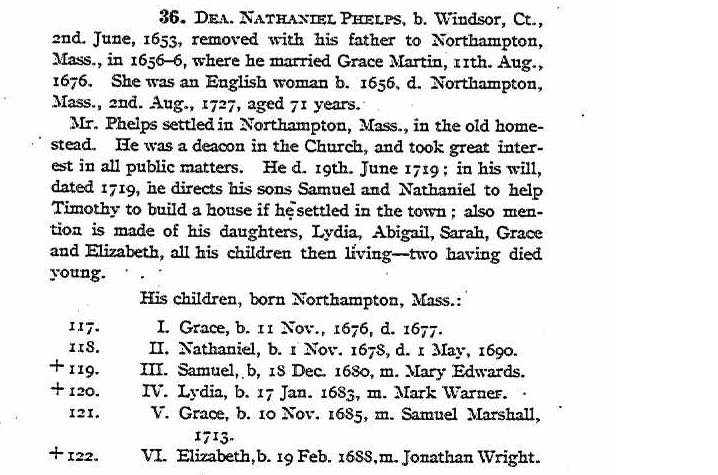
Nathaniel Phelps Jr 1653-1719
Biography
Nathaniel Phelps, Jr., was born on 2 June 1653 in Windsor, Hartford County, Connecticut.1,2
Nathaniel Phelps, Jr., married Grace Martin on 11 August 1676 in Northampton, Hampshire County, Massachusetts.2
Nathaniel Phelps, Jr., died on 19 June 1719 in Westfield, Hampden County, Massachusetts, at age 66.1,2 He was buried in Bridge Street Cemetery, Northampton, Hampshire County, Massachusetts.1
Nathaniel Phelps, Jr., married Grace Martin on 11 August 1676 in Northampton, Hampshire County, Massachusetts.2
Nathaniel Phelps, Jr., died on 19 June 1719 in Westfield, Hampden County, Massachusetts, at age 66.1,2 He was buried in Bridge Street Cemetery, Northampton, Hampshire County, Massachusetts.1
Nathaniel Phelps, Jr., lived between 1656 and 1719 in Northampton, Hampshire County, Massachusetts.2 ANCESTOR: President Rutherford B. Hayes.
| Last Edited | 16 November 2015 |
Citations
- [S908] Find A Grave, online www.findagrave.com, Nathaniel Phelps
Birth: Jun. 2, 1653
Windsor, Hartford County, Connecticut
Death: Jun. 19, 1719
Northampton, Hampshire County, Massachusetts
Family links:
Parents:
Nathaniel Phelps (1624 - 1702)
Elizabeth Copley Phelps (1628 - 1712)
Spouse:
Grace Martin Phelps (1656 - 1727)
Children:
Lydia Phelps Warner (1683 - 1765)*
Nathaniel Phelps (1692 - 1747)*
Sibling:
Nathaniel Phelps (1653 - 1719)
William Phelps (1657 - 1745)*
Burial: Bridge Street Cemetery
Northampton, Hampshire County, Massachusetts
Created by: Sharon Haskin Galitz
Record added: Jul 28, 2011
Find A Grave Memorial# 74055184. Hereinafter cited as Find A Grave. - [S756] Judge Oliver Seymour Phelps & Andrew T. Servin, editor, The Phelps Family of America and Their English Ancestors (Pittsburgh, Massachusetts: Eagle Publishing Co., 1899). Hereinafter cited as Phelps Family of America.
Abigail Phelps
F, #7450, b. 5 April 1655, d. 16 August 1756
Parents
| Father | Nathaniel Phelps, Sr. (b. 6 March 1624/25, d. 27 May 1702) |
| Mother | Elizabeth Unknown (b. circa 1620, d. 6 December 1712) |
| Pedigree Link |
Biography
Abigail Phelps was born on 5 April 1655 in Windsor, Hartford County, Connecticut.1
Abigail Phelps married John Alvord.
Abigail Phelps died on 16 August 1756 in Northampton, Hampshire County, Massachusetts, at age 101.1 She was buried in Northampton, Hampshire County, Massachusetts.
Abigail Phelps married John Alvord.
Abigail Phelps died on 16 August 1756 in Northampton, Hampshire County, Massachusetts, at age 101.1 She was buried in Northampton, Hampshire County, Massachusetts.
Her Ancestral File Number is Ancestral File Number:
| Last Edited | 11 May 2013 |
Citations
- [S756] Judge Oliver Seymour Phelps & Andrew T. Servin, editor, The Phelps Family of America and Their English Ancestors (Pittsburgh, Massachusetts: Eagle Publishing Co., 1899). Hereinafter cited as Phelps Family of America.