A Snelson DataBase and Index
Includes the Snelson Coat of Arms & Armory
Person Page 222
 |  |  |  |
Alice Roydon
F, #5532, Deceased
Interactive Pedigree Button
Parents
| Father | Richard Roydon (b. 1527) |
| Mother | Anne Powell |
Main Events
| User Reference Number | Alice Roydon; 8217 |
Arnulf II Unknown1,2
M, #5534, Deceased, b. about 960, d. 30 March 988
Interactive Pedigree Button
Parents
| Father | Baldwin III Unknown (b. about 936, d. 1 January 962) |
| Mother | Matilda Unknown (b. about 942, d. 25 May 1009) |
Family: Rosala (Suzanne) Unknown (b. 950, d. 13 December 1003)
| Son | Baldwin IV Unknown+ (b. about 980, d. 30 May 1036) |
Main Events
| User Reference Number | Arnulf II Unknown; 18842 |
| Residence | He resided Arnulf II of Flanders (960 or 961 – March 30, 988) was Count of Flanders from 965 until his death. He was the son of Baldwin III of Flanders and Matilda of Burgundy. Baldwin III died in 962, when Arnulf was just an infant, and with Arnulf's grandfather count, Arnulf I, still alive. When Arnulf I died three years later (965), the regency was held by their kinsman Baldwin Balso. By the time Arnulf attained his majority in 976, Flanders had lost some of the southern territory acquired by Arnulf I. The latter had given some parts of Picardy to King Lothar of France to help assure his grandson's succession, and gave Boulogne as a fief to another relative. Then early in Arnulf's minority Lothar had taken Ponthieu and given it to Hugh Capet, and the first counts of Guînes had established themselves. He married Rozala of Lombardy, daughter of Berengar II of Italy, and was succeeded by their son, Baldwin IV.1 |
| Birth Reg | He; Rosala (Suzanne) Unknown; 4th cousins 1 removed1 |
| Birth | He was born about 960.2,1 |
| His father Baldwin III Unknown died on 1 January 962. | |
| Marriage | Arnulf II Unknown and Rosala (Suzanne) Unknown were married in 968.2,3,1 |
| His son Baldwin IV Unknown was born about 980 in Flanders, France. | |
| Death | Arnulf II Unknown died on 30 March 988, at age ~28.2,1 |
| His wife Rosala (Suzanne) Unknown died on 13 December 1003. | |
| His mother Matilda Unknown died on 25 May 1009. |
Citations
Pippin the Younger Unknown1,2,3
M, #5543, Deceased, b. 715, d. 24 September 768
Interactive Pedigree Button
Parents
| Father | Charles Martel Unknown (b. 23 August 686, d. 22 October 741) |
| Mother | Rotrude Unknown (b. 690, d. 724) |
Family: Berthe (Bertrade) Unknown (b. 720, d. 12 July 783)
| Son | Charlemagne Unknown+ (b. 742, d. 28 January 814) |
Main Events
| User Reference Number | Pippin the Younger Unknown; 18717 |
| Residence | He resided See notes.1 |
| Note | Event Memos from GEDCOM Import... Residence Pippin the Younger (or Pepin; French, Pépin le Bref; Dutch Pepijn de Korte German, Pippin der Kleine, Pippin der Kurze, or Pippin der Jüngere) (714 – September 24, 768), often known under the mistranslation Pippin the Short or the ordinal Pippin III, was the king of the Franks. He was born in 714 in Jupille, close to the city of Liège, in what is today Belgium, where the Carolingian dynasty originated. That territory was then a part of the kingdom of Austrasia. His father was Charles Martel , mayor of the palace and duke of the Franks, and his mother was Chrotrud (690). On the death of Pippin's father, Charles Martel, in 741, power was passed down to Charles' legitimate sons, Pippin and Carloman as mayors of the palaces of Neustria and Austrasia respectively. Power may also have been intended for Charles' illegitimate son, Grifo, but he was imprisoned in a monastery by his two half-brothers. Carloman, who by all evidence was a deeply pious man, retired to a monastery in 747. This left Francia in the hands of Pippin as sole mayor of the palace and dux et princeps Francorum, a title originated by his grandfather and namesake Pippin of Heristal. Under the reorganization of Francia by Charles Martel the dux et princeps Francorum were the commanders of the armies of the Kingdom, in addition to their administrative duties as mayor of the palace, and specifically commander of the standing guard which Martel had begun maintaining year-around since Toulouse in 721. Upon their assumption, Pippin and Carloman, who had not proved themselves in battle in defense of the realm as their father had, installed the Merovingian Childeric III as king, even though Martel had left the throne vacant since the death of Theuderic IV. Childeric had the title of king, but he was a puppet. As time passed, and his brother bowed out of the picture, Pippin became discontent with the presence of any royal power but himself. At the time of Carloman's retirement, Grifo escaped his imprisonment and fled to Duke Odilo of Bavaria, who was married to Hiltrude, Pippin's sister. Odilo was forced by Pippin to acknowledge Frankish overlordship, but died soon after (January 18, 748). Pippin invaded Bavaria and installed Tassilo III as duke under Frankish overlordship. Since Pippin had control over the magnates and actually had the power of the king, he decided it was time to do what his father had never bothered to do: make the Carolingian name royal in law as well as fact. Pippin asked Pope Zachary who should be the royal ruler: the person with the title of King, or the person who makes the decisions as King. Since the Pope depended on the Frankish armies for his independence, and had depended on them for protection from the Lombards since the days of Charles Martel, and Pippin, as his father had, controlled those armies, the Pope's answer was determined well in advance. The Pope agreed that the de facto power was more important than the de jure power. Thus, Pippin, having obtained the support of the papacy, discouraged opposition to his house. He was elected King of the Franks by an assembly of Frankish leading-men (it must be noted he had a large portion of his army on hand, in the event that the nobility inclined not to honor the Papal Bull) and anointed at Soissons, perhaps by Boniface, Archbishop of Mainz. Meanwhile, Grifo continued his rebellion, but was eventually killed in the battle of Saint-Jean de Maurienne in 753. Childeric III was deposed, his hair was shaved off and he was confined to a monastery. He was the last of the Merovingians. He added to that power after Pope Stephen II traveled all the way to Paris to anoint Pippin in a lavish ceremony at Saint Denis Basilica, bestowing upon him the additional title of patricius Romanorum (Patrician of the Romans). As life expectancies were short in those days, and Pippin wanted family continuity, the Pope also anointed Pippin's sons, Charles (eventually known as Charlemagne) and Carloman. Pippin's first major act was to go to war against the Lombard king Aistulf, who had a policy of expansion into the ducatus Romanum, as a partial repayment for papal support in his quest for the crown. Victorious, he forced the Lombard king to return property seized from the Church and confirmed the papacy in possession of Ravenna and the Pentapolis, the so-called Donation of Pepin whereby the Papal States was founded. In 759, he drove the Saracens out of Gaul with the capture of Narbonne and then consolidated his power further by integrating Aquitaine into the kingdom. In taking Narbonne, and formally annexing Aquitaine (whose status was always dependant on the strength of her suzerains), he completed the work of his father save for one last task: fully subduing the Saxons. He was preparing for war against them when his health began to fail, and thus, this final task was left for his son, the great Charlemagne. Pippin died at Saint Denis in 768 and is interred there in the basilica with his wife Bertrada. Historical opinion often seems to regard him as the lesser son and lesser father of two greater men, though a great man in his own right. He continued to build up the heavy cavalry which his father had begun. He maintained the standing army that his father had found necessary to protect the realm and form the core of its full army in wartime. He not only maintained his father's policy of containing the Moors, he drove them over and across the Pyrenees with the capture of Narbonne. He continued his father's expansion of the Frankish church (missionary work in Germany and Scandinavia) and the infrastructure (feudalism) that would prove the backbone of medieval Europe. His rule, while not as great as either his father's or son's, was historically important and of great benefit to the Franks as a people. It can certainly be argued that Pippin's assumption of the crown, and the title of Patrician of Rome, were harbingers of his son's imperial coronation which is usually seen as the founding of the Holy Roman Empire. He certainly made the Carolingians de jure what his father had made them de facto—the ruling dynasty of the Franks and the foremost power of Europe. While not known as a great general, he was undefeated during his lifetime. In 740, Peppin married Bertrada of Laon, his second cousin. (Her father, Charibert, was the son of Pippin II's brother, Martin of Laon.) Of their children, two sons and a daughter survived to adulthood. * Charles (April 2, 742 – January 28, 814), the great Charlemagne * Carloman (751 – December 4, 771) * Gisela (757 – 810.) |
| Birth Reg | He; Berthe (Bertrade) Unknown; 2nd Cousins1 |
| Birth | He was born in 715.2,1 |
| His mother Rotrude Unknown died in 724. | |
| Marriage | Pippin the Younger Unknown and Berthe (Bertrade) Unknown were married in 740.2,1 |
| His father Charles Martel Unknown died on 22 October 741. | |
| His son Charlemagne Unknown was born in 742. | |
| Death | Pippin the Younger Unknown died on 24 September 768, at age ~53.2,1 |
| His wife Berthe (Bertrade) Unknown died on 12 July 783. |
Citations
Michael Edward English
M, #5544, Deceased, b. 16 June 1907, d. 28 July 1976
Interactive Pedigree Button
Person Exhibits - click on camera icons
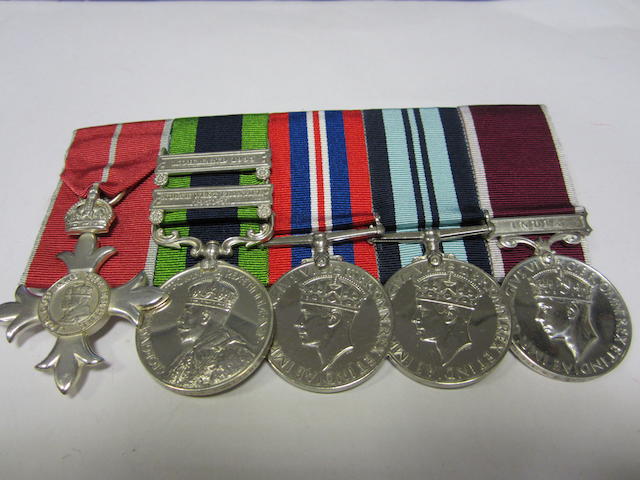
Gongs Michael Edward English
Parents
| Father | Patrick English (b. 20 March 1872, d. 25 January 1936) |
| Mother | Minnie Frances Barry (b. 7 October 1870) |
Family: Mary Isabella Lawrenson (b. 21 October 1911, d. 6 December 1988)
| Son | Michael John English (b. 4 March 1933, d. about January 2002) |
| Relationship | 2nd cousin 1 time removed of Adrian John Snelson |
| Person References | Brigid Troy bef 1830 Johannes English 1815 - 1867 |
Main Events
| User Reference Number | Michael Edward English; 23850 |
| Award | Michael Edward received an Award. A Second World War M.B.E. to Staff Sergeant M.E.English, Indian Army Corps of Clerks, The Most Excellent Order of the British Empire, M.B.E., 2nd type, Military Division; India General Service 1908-35, two bars, North West Frontier 1930-31; Mohmand 1933 (1058353 P-A-Sjt.M.E.English, I.C.C.); War Medal; India Service Medal; Army Long Service and Good Conduct, G.VI.R. with India (S-Sgt. M.E.English, IACC). Court mounted. Very fine or better. (5) * M.B.E. London 1.1.1945. Staff Sergeant Michael Edward English enlisted into the Royal Garrison Artillery on the 14th August 1924, aged 24 and 6 months. He transfers to the Indian Army Corps of Clerks, he was a Paid Acting Sergeant at the time of the North West Frontier 1930-31. Serving in WW2 he was awarded his Long Service Medal in November 1944, at which time he was ranked a Staff Sergeant in the I.A.C.C. He was granted an Emergency Commission as a Lieutenant (Assistant Commissary) in the I.A.C.C. on the 2nd July 1945. He was last mentioned in the Indian Army List of April 1948 as a War Substantive Lieutenant and Temporary Captain. Returning to England, he died in Preston, Lancashire on 28 July 1976. Ex John Tamplin collection. |
| Note | Assuming Blackheath is not in NSW, Australia. |
| Birth | He was born on 16 June 1907 in Blackheath, London, England. |
| Baptism | He was baptised on 23 June 1907 in Our Lady of Grace RC Church Address: Charlton, London. |
| Marriage | Michael Edward English and Mary Isabella Lawrenson were married about 1932 in Peshawar, Bengal, India. |
| His son Michael John English was born on 4 March 1933 in Peshawar, Bengal, India. | |
| His father Patrick English died on 25 January 1936 in London, England. | |
| Death | Michael Edward English died on 28 July 1976, at age 69, in Preston, Lancashire, England, Address: 35 Avenham Road. |
| His wife Mary Isabella Lawrenson died on 6 December 1988 in Ashton on Ribble, Preston, Lancasire. |
Census
| Label and Year | Manual |
|---|---|
| Census 1911 | Michael Edward English Id #5,544 (Principal) was at home on Census night 1911 at Teddington; Address: 39 Blackmore's Grove Witness Role: son Original Documents, Source and Citations here |