
Avery-Hanson Genealogy - Person Sheet
Avery-Hanson Genealogy - Person Sheet


OccupationSchool teacher in TN, Baptist minister in MO
ReligionBaptist
FatherPeter1 (Petrus) AVERY Sr. (<1739-ca1823)
MotherMary (Maria, "Polly") YAPLE (1758->1840)
Spouses
FatherRev. John GREEN
MotherRachel MACKEY
ChildrenPonsonby Greene (1820-1863)
William Lane (1822-1875)
Robeson (Robinson, Robert) Lafayette (1824-1889)
Thomas Flavius (1827-1843)
Nancy Ann (1830-1901)
Susan Jane (1832-1910)
Angus Clark (1836-1911)
James Mason (1838-1903)
Notes for Rev. Henry AVERY
1821,2: Henry and Elizabeth injured in runaway accident in AL.135
1830: White Co., TN, head of household138
males: 2 x <5, 2 x 5<10, 1 x 30<40
females: 1 x <5, 1 x 30<40
1830: moved from TN to MO via St. Louis & Morgan Co's., MO
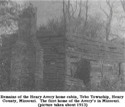
18 Mar 1832: First settler of Tebo Twp, Henry Co., then Rives Co., and built the first house of hewn logs in Henry Co. (see picture), served under General Andrew Jackson in the Seminole Indian war, as well as in the war of 1812. He was a personal friend of “Old Hickory” and corresponded with him for many years and while Jackson was President. 139 He was Jackson’s private secretary and a member of his staff at the time of the battle of New Orleans. He was the first Justice of the Peace in Tebo Twp., Henry Co., MO
bio:AVERY, Henry
source: 1883 History of Henry Missouri , National Historical Co., pg: 492
--- Rev. Henry Avery. Among the early pioneers of this county there are none who were better known or whose memory is more favorably cherished than the subject of this sketch. He was born in Roane County, Tennessee, October 18, 1793, and was the son of Peter Avery, who emigrated to
Tennessee at an early day. The youth of Henry was spent on a farm until the war of 1812, when he enlisted and served as a private; he also served in the war against the Seminole Indians under General Jackson, and was promoted for meritorious conduct. He was married on the 25th of November, 1819, to Miss Elizabeth Green, of White County, Tennessee. In 1830 he emigrated to Missouri, and after spending a season in St. Louis County continued his course westward and raised a crop in Morgan County, and thence moved to what is now Henry County, in July, 1831, and was one of the first to identify himself with the interests of the county. He made his permanent settlement in Tebo Township March 18, 1832, and engaged successfully in agricultural pursuits. He was probably the first man in the county who broke prairie and put in a crop, and he erected the first hewn log house in the county, which is still standing, and a cut of which is to be seen elsewhere. In this house the first white child of the county, Susan Jane Avery, (now Mrs. William H. Roberts, of Clinton,) was born. He was the first justice of the peace of the county, and the first term of the county court was held in his house on May 4 and 5, 1835, when the county first had a separate organization. The pioneer store in the county was erected and opened on his premises by Stephen Clark. In his religious preferences he was an old school Baptist, and in 1826 united with the Big Fork Church in Tennessee. After his removal to this county he became a constituent member of High Point Church, Johnson County, in 1832, and in the following spring he was ordained a preacher by a Presbytery consisting of Elders J. Warder, J. White, Thomas Ricketts and William Simpson. From this time until his death, though called an Old School Baptist, he was a great missionary, working hard on his farm most of the time and spending often from Friday until Monday preaching the Gospel in all the surrounding country without fee or reward; going east at times as far as St. Louis, and west beyond the state limits, preaching to the Indians. Through industry and strict economy he gained a competency. His house was the home of many a weary traveler, and in it elections, courts and preaching were held. He held a public debate with Elder Joshua Page, a Campbellite in Henry County, the first, perhaps, held as far west, in 1842. He had a good English education and his preaching was plain, faithful and earnest, at the same time pathetic and persuasive, and he might in truth be styled one of the old fashioned preachers and teachers, laboring as Paul did, with his own hands for a support, and the local poet might have said of him as it did of one who labored with him in the early days of his ministry: (Omitted poem) Mr. Avery died September 26, 1845, surrounded by his family to whom he spoke loving words, and after sending affecting messages to his ministerial brethren and others with whom he had been intimate as a co-laborer. The last words he was heard to utter were, "I have fought a good fight," and peacefully fell asleep. Three sons, R. L. Avery, now residing on the old homestead, A. C. Avery and J. M. Avery, of Clinton, and two daughters, Mrs. Nancy A. Fewell and Mrs. William H. Roberts, still survive him.
1830: White Co., TN, head of household138
males: 2 x <5, 2 x 5<10, 1 x 30<40
females: 1 x <5, 1 x 30<40
1830: moved from TN to MO via St. Louis & Morgan Co's., MO
18 Mar 1832: First settler of Tebo Twp, Henry Co., then Rives Co., and built the first house of hewn logs in Henry Co. (see picture), served under General Andrew Jackson in the Seminole Indian war, as well as in the war of 1812. He was a personal friend of “Old Hickory” and corresponded with him for many years and while Jackson was President. 139 He was Jackson’s private secretary and a member of his staff at the time of the battle of New Orleans. He was the first Justice of the Peace in Tebo Twp., Henry Co., MO
bio:AVERY, Henry
source: 1883 History of Henry Missouri , National Historical Co., pg: 492
--- Rev. Henry Avery. Among the early pioneers of this county there are none who were better known or whose memory is more favorably cherished than the subject of this sketch. He was born in Roane County, Tennessee, October 18, 1793, and was the son of Peter Avery, who emigrated to
Tennessee at an early day. The youth of Henry was spent on a farm until the war of 1812, when he enlisted and served as a private; he also served in the war against the Seminole Indians under General Jackson, and was promoted for meritorious conduct. He was married on the 25th of November, 1819, to Miss Elizabeth Green, of White County, Tennessee. In 1830 he emigrated to Missouri, and after spending a season in St. Louis County continued his course westward and raised a crop in Morgan County, and thence moved to what is now Henry County, in July, 1831, and was one of the first to identify himself with the interests of the county. He made his permanent settlement in Tebo Township March 18, 1832, and engaged successfully in agricultural pursuits. He was probably the first man in the county who broke prairie and put in a crop, and he erected the first hewn log house in the county, which is still standing, and a cut of which is to be seen elsewhere. In this house the first white child of the county, Susan Jane Avery, (now Mrs. William H. Roberts, of Clinton,) was born. He was the first justice of the peace of the county, and the first term of the county court was held in his house on May 4 and 5, 1835, when the county first had a separate organization. The pioneer store in the county was erected and opened on his premises by Stephen Clark. In his religious preferences he was an old school Baptist, and in 1826 united with the Big Fork Church in Tennessee. After his removal to this county he became a constituent member of High Point Church, Johnson County, in 1832, and in the following spring he was ordained a preacher by a Presbytery consisting of Elders J. Warder, J. White, Thomas Ricketts and William Simpson. From this time until his death, though called an Old School Baptist, he was a great missionary, working hard on his farm most of the time and spending often from Friday until Monday preaching the Gospel in all the surrounding country without fee or reward; going east at times as far as St. Louis, and west beyond the state limits, preaching to the Indians. Through industry and strict economy he gained a competency. His house was the home of many a weary traveler, and in it elections, courts and preaching were held. He held a public debate with Elder Joshua Page, a Campbellite in Henry County, the first, perhaps, held as far west, in 1842. He had a good English education and his preaching was plain, faithful and earnest, at the same time pathetic and persuasive, and he might in truth be styled one of the old fashioned preachers and teachers, laboring as Paul did, with his own hands for a support, and the local poet might have said of him as it did of one who labored with him in the early days of his ministry: (Omitted poem) Mr. Avery died September 26, 1845, surrounded by his family to whom he spoke loving words, and after sending affecting messages to his ministerial brethren and others with whom he had been intimate as a co-laborer. The last words he was heard to utter were, "I have fought a good fight," and peacefully fell asleep. Three sons, R. L. Avery, now residing on the old homestead, A. C. Avery and J. M. Avery, of Clinton, and two daughters, Mrs. Nancy A. Fewell and Mrs. William H. Roberts, still survive him.
Notes for Rev. Henry AVERY
(From the St. Louis Globe of Oct. 4 <year missing>)
A PIONEER PREACHER
Globe-Democrat tells of Rev. Henry Avery
In an extended write-up of Henry County published in Sunday’s Globe Democrat there was much of histor-ical and present day interest. Below will be found a very interesting account of that pioneer preacher, Rev. Henry Avery, and the rest of the story telling of the county and of Clinton will appear later.
He was known as the fighting farmer-parson. He would as soon kill a bear as preach a sermon and he did both equally well. He could flay by word of mouth those who had strayed from the paths of righteousness and dared to wrestle with a catamoun in his own lair. More than once he left his oxen in the field while he repaired to the near-by settlement to hold missionary services that sometimes stretched into days. For a score of years he never pretended to work his farm from Friday afternoon until Monday morning. That period of time belonged to the Lord, he said and it was nothing for him to ride fifty or a hundred miles to an Indian settlement in an attempt to win the redskins to Christianity. Rev. Henry Avery, as hard-shell Baptist as ever came to Missouri is the fighting farmer-parson referred to, and he has left an indelible mark upon the history of Henry County which he selected as early as 1831 as the scene of his activity.
The reverend gentleman was as quaint a character as one might find in all the pages of Missouri history. He was a rugged, stalwart personage that stood above his fellows even in the days when a man had to be rug-ged and stalwart if he expected to wrest a living from the wilderness. But h e was more than plain pioneer. He not only endured all that such a life included, but he set for himself an additional task, that of a missionary both to white and red men.
Rev. Avery came of pioneer stock. His father was one of the first settlers in Tennessee, Henry being born in Roane county in 1793. His youth was spent on his father’s farm but he early showed signs of his desire for a more active life and with the declaration of war in 1812 he was off to it, serving as a private. That war concluded he waited a few years and then participated in the Seminole war serving under Andrew Jackson. He was promoted for meritorious service during this war.
Having married in 1819, he moved to Missouri in 1830 and for some time was a resident of St. Louis county but that community became too crowded and he moved westward, to Morgan county and then in July, 1831 he came to what is now Henry county and became at once one of its first settlers and its most progressive far-mer. He brought the first plow to the county. His cabin was the first to sport glass in its tiny window. He was the first Justice of the Peace in the county. The first term of the County Court was held in his cabin and the first store erected in the county was on his premises, altho it was owned by Stephen Clark.
But this active farmer was not yet a preacher. He had always been of a religious nature and in 1826 had joined an old school Baptist church at Big Fork, Tenn., but it was not until 1832 after he had united with High Point Church in the neighboring county of Johnson that he conceived the idea of being a missionary. He studied dili-gently and was ordained the following year by a Presbytery of elders. Then began his career as a circuit riding clergyman who, without fee or other financial reward spent at least half of his time in gratuitous preach-ing. It is said that on some of his visits he went as far east as St. Louis and frequently his peregrinations to the west carried him far into Kansas.
He possessed a facility to handle English that was convincing to his hearer who admired both the erudi-tion of the man and his high qualities of manhood. A preacher who could not only quote the Scriptures lavishly but could also outshoot his fellows with the rifle, who could plow the straightest furrow in the county and wrestle with the strongest, possessed talents that quite easily made him a most successful missionary.
Mention is made of Rev. Henry. Avery because he was not only typical of the pioneering spirit that set-tled Henry County but also was the leader among the intrepid groups that pushed their way into that country in the early thirties and laid the foundation stones upon which the county was founded.
A PIONEER PREACHER
Globe-Democrat tells of Rev. Henry Avery
In an extended write-up of Henry County published in Sunday’s Globe Democrat there was much of histor-ical and present day interest. Below will be found a very interesting account of that pioneer preacher, Rev. Henry Avery, and the rest of the story telling of the county and of Clinton will appear later.
He was known as the fighting farmer-parson. He would as soon kill a bear as preach a sermon and he did both equally well. He could flay by word of mouth those who had strayed from the paths of righteousness and dared to wrestle with a catamoun in his own lair. More than once he left his oxen in the field while he repaired to the near-by settlement to hold missionary services that sometimes stretched into days. For a score of years he never pretended to work his farm from Friday afternoon until Monday morning. That period of time belonged to the Lord, he said and it was nothing for him to ride fifty or a hundred miles to an Indian settlement in an attempt to win the redskins to Christianity. Rev. Henry Avery, as hard-shell Baptist as ever came to Missouri is the fighting farmer-parson referred to, and he has left an indelible mark upon the history of Henry County which he selected as early as 1831 as the scene of his activity.
The reverend gentleman was as quaint a character as one might find in all the pages of Missouri history. He was a rugged, stalwart personage that stood above his fellows even in the days when a man had to be rug-ged and stalwart if he expected to wrest a living from the wilderness. But h e was more than plain pioneer. He not only endured all that such a life included, but he set for himself an additional task, that of a missionary both to white and red men.
Rev. Avery came of pioneer stock. His father was one of the first settlers in Tennessee, Henry being born in Roane county in 1793. His youth was spent on his father’s farm but he early showed signs of his desire for a more active life and with the declaration of war in 1812 he was off to it, serving as a private. That war concluded he waited a few years and then participated in the Seminole war serving under Andrew Jackson. He was promoted for meritorious service during this war.
Having married in 1819, he moved to Missouri in 1830 and for some time was a resident of St. Louis county but that community became too crowded and he moved westward, to Morgan county and then in July, 1831 he came to what is now Henry county and became at once one of its first settlers and its most progressive far-mer. He brought the first plow to the county. His cabin was the first to sport glass in its tiny window. He was the first Justice of the Peace in the county. The first term of the County Court was held in his cabin and the first store erected in the county was on his premises, altho it was owned by Stephen Clark.
But this active farmer was not yet a preacher. He had always been of a religious nature and in 1826 had joined an old school Baptist church at Big Fork, Tenn., but it was not until 1832 after he had united with High Point Church in the neighboring county of Johnson that he conceived the idea of being a missionary. He studied dili-gently and was ordained the following year by a Presbytery of elders. Then began his career as a circuit riding clergyman who, without fee or other financial reward spent at least half of his time in gratuitous preach-ing. It is said that on some of his visits he went as far east as St. Louis and frequently his peregrinations to the west carried him far into Kansas.
He possessed a facility to handle English that was convincing to his hearer who admired both the erudi-tion of the man and his high qualities of manhood. A preacher who could not only quote the Scriptures lavishly but could also outshoot his fellows with the rifle, who could plow the straightest furrow in the county and wrestle with the strongest, possessed talents that quite easily made him a most successful missionary.
Mention is made of Rev. Henry. Avery because he was not only typical of the pioneering spirit that set-tled Henry County but also was the leader among the intrepid groups that pushed their way into that country in the early thirties and laid the foundation stones upon which the county was founded.